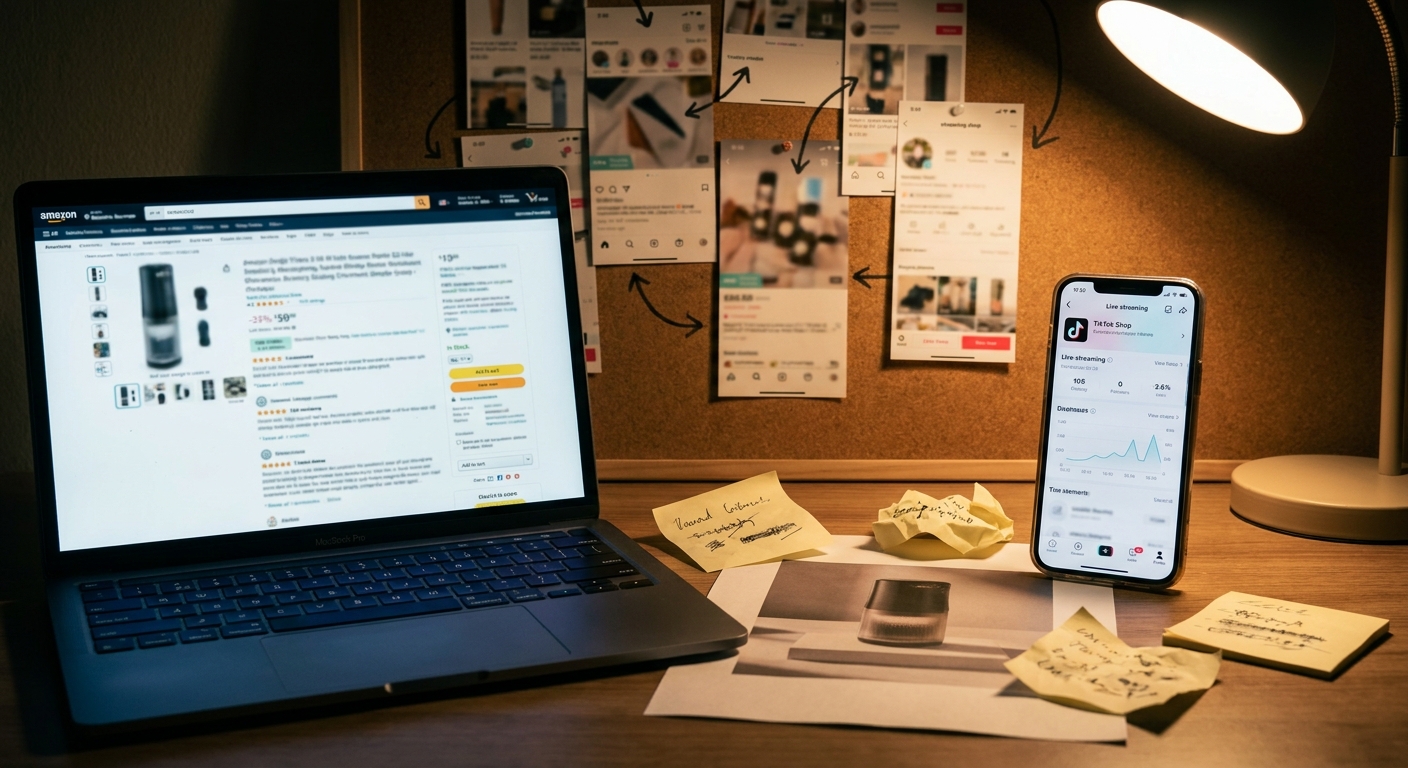
You are not crazy if TikTok Shop product research feels like a money pit. One week a gadget looks hot. The next week your ads flop, creators ignore it, and you are stuck with a product that looked amazing on trend charts but had no staying power. That is the problem with copying what everyone else is already watching. By the time a product shows up on bestseller lists, the easy margin is often gone. A smarter move is starting one step earlier. Instead of asking what is viral right now, ask what people are already buying on Amazon, what they keep reordering, and what they are returning or complaining about. That is the quiet little playbook many sharper sellers are using. They are not just hunting winners. They are hunting flawed winners. If you know how to find winning products for TikTok Shop from Amazon data, you can spot products with proven demand and obvious fixable weaknesses before the crowd piles in.
⚡ In a Hurry? Key Takeaways
- Use Amazon as your first filter. Look for products with strong review growth, repeat-buy language, and clear complaint patterns.
- Start with products people already understand in a short video, then improve the weak spot buyers mention most often.
- This is safer than chasing random viral gadgets because you are picking from proven demand, not pure hype.
What “Receipt Remix” actually means
The phrase sounds fancy, but the idea is simple. You look at Amazon like a giant public receipt book. It shows what people are buying at scale, how fast reviews are stacking up, what they love enough to repurchase, and what keeps disappointing them.
Then you remix that information for a social shopping platform.
You are not copying a listing word for word. You are using Amazon demand signals to choose a product category that already works, then shaping a better version, a better bundle, or a better angle for TikTok Shop, Instagram Shop, or YouTube Shopping.
That is the hidden advantage. Amazon tells you what sells. The complaints tell you where the opening is.
Why TikTok bestseller charts are not enough anymore
Most sellers are staring at the same dashboards. TikTok Shop rankings. Ad libraries. Amazon influencer storefronts. Creator roundups. “Top 10 must-sell products” videos.
The result is predictable. Too many people pile into the same categories. Margins shrink. CPMs rise. Creators get flooded with the same offers. Your “winning product” turns into everybody else’s clearance item.
Amazon data helps because it sits a little earlier in the chain. It shows broader buyer behavior, not just what is being pushed hardest by affiliate creators this week.
How to find winning products for TikTok Shop from Amazon data
1. Start with review velocity, not just star rating
A product with 4.8 stars is nice. A product gaining reviews quickly is more useful.
Review velocity means the pace at which new reviews are coming in. If a product picked up 800 reviews over years, that is less exciting than one that added 150 reviews in the last month. Fast review growth usually points to current demand, not old demand.
What to look for:
- Recent reviews posted daily or several times a week
- Multiple reviewers mentioning they “just bought another”
- Consistent sales rank strength across a category
- A product that seems to be climbing, not coasting
For social commerce, this matters because momentum helps creators. It is much easier to sell a product people are already warmed up to than to educate the market from scratch.
2. Hunt for repeat purchase language
This is one of the cleanest signals. If buyers say things like “my second order,” “I buy this every month,” “I got one for my sister after trying mine,” or “reordered because the first one worked,” pay attention.
Repeat purchase language tells you two things. First, demand is real. Second, the product has a clear use case people understand quickly.
That second part is gold for TikTok Shop.
Products that do well in short-form video usually pass a very basic test. A person can see the problem and the payoff in seconds. If Amazon buyers keep returning to a product, it often means the benefit is easy to grasp and easy to justify.
3. Read the complaints like a product designer
This is where the “guaranteed winner” idea gets closer to reality. Nothing is truly guaranteed, of course. But this is where your odds improve.
Open the low-star reviews and look for patterns.
You are not looking for random angry comments. You are looking for repeated complaints such as:
- “Works, but feels cheap”
- “Love the idea, hate the packaging”
- “Too small for what the listing showed”
- “Battery dies too fast”
- “Leaks after a week”
- “Instructions are terrible”
- “Wish it came with two”
That is your opening. If people clearly want the product but keep hitting the same frustration, you may have found a category worth entering.
4. Separate fatal flaws from fixable flaws
Not every complaint is an opportunity.
If customers are saying the whole concept is pointless, skip it. If they are saying the product breaks because the underlying design is bad, be careful. But if the problem is packaging, sizing, accessories, clarity, material quality, or bundling, that is often fixable.
Good examples of fixable flaws:
- Add clearer instructions
- Use stronger materials
- Bundle refill parts or extra pieces
- Improve size labeling
- Show honest demos in content
- Create a version for a specific niche use case
That is the remix part. You are not inventing demand. You are removing friction from proven demand.
5. Check whether the product can actually work on video
Some Amazon winners are terrible TikTok products. They may sell through search but flop in feeds.
Ask these questions:
- Can the problem be shown in under 5 seconds?
- Is the payoff visual?
- Can a creator demo it without a long explanation?
- Would a customer understand why it matters before the caption finishes?
If the answer is no, it may still be a good Amazon SKU, but not a great social commerce SKU.
The quiet sweet spot: flawed products with obvious demand
This is where smaller brands can still win.
Big catalogs move slowly. They may have the sales volume, but they are often slow to fix packaging, tweak bundles, refresh instructions, or reposition a product for a niche audience. A small seller can do that much faster.
Say you find an Amazon kitchen tool with strong recent review growth. Buyers love the outcome, but low-star reviews complain that it is too flimsy and comes with confusing instructions. That is not a dead product. That is a product gap.
Your version could use thicker material, a simple instruction card, and content that shows the exact before-and-after result in 10 seconds.
Same demand. Better execution.
A simple product filtering checklist
If you want a practical system, use this before you spend on samples or ads.
Green lights
- Recent review growth is steady
- Buyers mention reordering or buying extras
- The use case is easy to show on camera
- Complaints are specific and fixable
- The product solves a common annoyance
- There is room to bundle, niche down, or improve quality
Yellow lights
- Reviews are strong but old
- Demand exists, but the demo is boring
- Complaints are mixed and hard to summarize
- The category is overloaded with nearly identical listings
Red lights
- Most low reviews say it does not work at all
- Repeat purchase language is missing
- Return complaints point to safety or reliability issues
- The product needs too much explanation to sell socially
What sellers often miss
Many people use Amazon data only to copy top sellers. That is the lazy version, and it usually leads to race-to-the-bottom competition.
The better move is to use Amazon as a demand map, not a copy machine.
Look for:
- Products with strong desire but poor presentation
- Items that are useful but badly bundled
- Popular products that confuse first-time buyers
- Review sections full of “almost perfect” comments
“Almost perfect” is where a lot of money hides.
How to test without burning cash
Once a product clears your Amazon filter, do not jump straight into broad ad testing.
Start smaller.
Use sample content first
Create 3 to 5 short videos around different angles:
- The problem it solves
- The most satisfying visual result
- The flaw your version fixed
- A niche audience angle
- A bundle or value angle
Test with creators before big inventory bets
Send samples to a handful of creators who already make problem-solution content. Watch which talking points they naturally use. That often reveals the strongest hook faster than paid ads do.
Read comments as fresh research
Comments on creator videos can validate the same things Amazon reviews hinted at. People will tell you if they already use something similar, what they hate about current options, and whether your angle makes sense.
What this playbook is really buying you
It is buying you better odds.
You are still testing. You are still taking risk. But you are no longer picking products out of pure trend noise. You are starting with proof of demand, proof of repeat behavior, and proof of what needs fixing.
That is a much smarter place to start than chasing the same crowded winners everybody else found on a public TikTok Shop chart.
At a Glance: Comparison
| Feature/Aspect | Details | Verdict |
|---|---|---|
| TikTok bestseller charts | Show what is already hot, but often after competition has crowded in | Useful for validation, weak for early discovery |
| Amazon review velocity and repeat-buy signals | Helps spot current demand and products customers already understand | Strong first filter for safer SKU selection |
| Return complaints and low-star review patterns | Reveals fixable weaknesses like sizing, durability, packaging, or instructions | Best place to find product-gap opportunities |
Conclusion
Right now, too many sellers are watching the same TikTok Shop bestseller charts and Amazon influencer storefronts, and that is exactly why margins keep getting squeezed in the same handful of categories. A better move is to start with Amazon’s messier but more useful clues. Review velocity shows what is moving now. Repeat purchase language shows what customers truly value. Return complaints and low reviews show where the product is falling short. Put those together and you get a much calmer, more practical way to choose what to sell next. For small brands, this is one of the smartest ways to spot product gaps that bigger catalogs cannot fix quickly. It will not remove all risk, but it can help you pick safer SKUs for TikTok Shop, Instagram, and YouTube Shopping without gambling on random gadgets or lighting money on fire with broad ad tests.