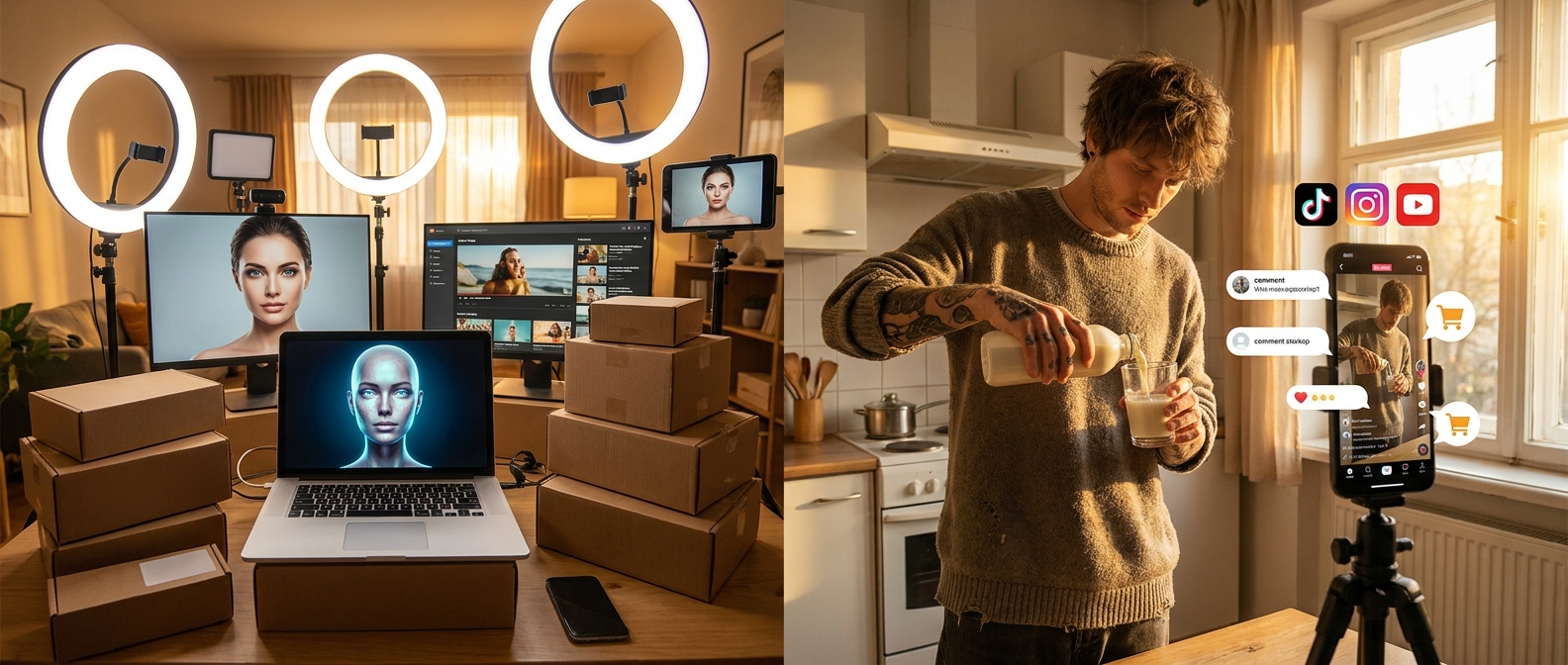
If you make TikTok Shop or Amazon promo videos, this is the kind of week that can make your stomach drop. Creators who relied on AI voiceovers, avatar presenters, recycled stock clips, and polished but generic product edits are finding out those shortcuts may now be costing them real money. Some are seeing campaign invites dry up. Others are getting mysterious “misleading content” warnings, weak search placement, or videos that simply stop moving. The frustrating part is that TikTok and brands are not always saying this plainly. But the pattern is getting hard to ignore. A quiet shift is happening toward what many creators are calling a real-body reel standard. Brands want to see an actual person, using an actual product, in an actual setting. If your content looks too synthetic, too templated, or too detached from real use, this tiktok shop ai crackdown authentic content shift could force a reset fast. For many creators, that means re-shooting their best-selling content within days, not months.
⚡ In a Hurry? Key Takeaways
- TikTok Shop and brand partners appear to be downgrading AI-heavy promo videos in favor of clearly human, original product demos.
- If your content uses cloned voices, stock-heavy edits, or avatar reviews, start re-shooting with your real face, hands, home, and honest product use this week.
- The danger is not just lower views. It can mean fewer campaign offers, misleading-content flags, weaker search visibility, and lost sales.
What is the new “real-body reel” standard?
It is not an official TikTok label. It is the easiest way to describe what creators are running into.
Videos that look unmistakably human are being treated as safer bets. Think face-to-camera intros, hands-on demos, natural speech, normal room lighting, real homes, real desks, real kitchens, and clear proof that the creator actually used the product.
On the flip side, videos that feel manufactured are starting to look risky. That includes AI voice narration with no person on screen, avatar “reviews,” generic stock B-roll, repeated clips used across multiple products, and scripts that sound like they were written by a machine and never touched by a human.
This matters because trust is now part of the ranking and monetization game. If a platform or brand thinks your content is low-trust commercial filler, your reach can sink without any dramatic account ban.
Why creators are panicking now
Because the penalties are quiet.
You do not always get a clear message saying, “Your video was deprioritized because it looked AI-generated.” Instead, creators report things like:
- New shop videos getting almost no traffic
- Product review clips flagged as misleading
- Denied appeals with vague explanations
- Fewer affiliate invitations or brand approvals
- Content indexed poorly in search
- Older videos still earning, while newer AI-style uploads stall out
That makes this harder to spot. Many creators think they just had a bad posting week. In reality, their whole content style may have slipped into a low-trust bucket.
What likely changed behind the scenes
TikTok, agencies, and major brands have strong reasons to clamp down on synthetic-looking shop content.
1. Buyer trust is fragile
If shoppers feel tricked by fake-looking reviews or robotic endorsements, they buy less. That hurts the whole marketplace.
2. AI made spam too easy
One person can now pump out dozens of promo videos in a day with cloned audio, stock footage, and simple templates. Platforms know this.
3. “Original” now means more than just not stolen
A video can be technically new and still feel unoriginal if it uses the same script pattern, same pacing, same visual structure, and same artificial delivery as thousands of others.
4. Brands do not want reputation problems
No marketing team wants their product attached to content that looks fake, deceptive, or lazy. Even if it converts in the short term, it can backfire.
The content styles most at risk
If your page is full of these, take it seriously:
- Text-to-speech or cloned voiceovers with no real speaker visible
- AI avatars pretending to review products
- Mostly stock footage instead of your own clips
- Fast-cut listicle style videos with no proof of product use
- Reviews that show a sealed box more than the product in action
- Near-identical hooks and scripts posted across many items
- “I bought this and wow” testimonials that clearly were not filmed in real use
None of these automatically mean punishment. But stack several together and your content can start looking like the exact thing platforms want less of.
What “authentic content” actually looks like now
This is where many creators get confused. Authentic does not mean low effort. It means believable.
Good signals include:
- Your face or hands on screen early in the video
- Your natural speaking voice, even if lightly edited
- Visible use of the product in a real setting
- Small imperfections like normal room sound or casual transitions
- Specific comments that only a real user would make
- Before-and-after proof, setup footage, or usage over time
- Balanced claims instead of overhyped promises
In plain English, the video should feel like you actually lived with the item for at least a little while.
The 7-day reset plan for creators
If you think your account has drifted too far into AI-heavy content, do not wait for a perfect strategy. Start a practical reset this week.
Day 1: Audit your last 20 videos
Make a simple list. Which videos include your real face, voice, hands, and environment? Which ones rely on AI audio, stock clips, or generic edits?
If most of your recent posts could have been made by anybody with the same template, that is your warning sign.
Day 2: Pick 3 products to re-shoot
Start with products that already sold well or have active commission potential. There is no point redoing weak offers first.
Choose items you can genuinely demonstrate. Everyday products work best because they are easy to show naturally.
Day 3: Film real usage clips
Get multiple angles. Show setup, handling, close-ups, the product solving a real problem, and your reaction.
Film in places where the product would normally live. Kitchen gadget in a kitchen. Desk accessory on your desk. Beauty tool in a bathroom mirror setup.
Day 4: Record your own voice
You do not need radio-quality audio. You need credibility.
Speak like a person, not a pitch deck. Say what surprised you, what annoyed you, what worked best, and who should skip it.
Day 5: Rewrite your hooks
Avoid canned opener lines that sound machine-made. Instead of “This viral product changed my life,” try something more specific, like “I thought this was gimmicky until I used it for three mornings.”
Day 6: Post 2 to 3 human-first videos
Do not dump ten at once. Give the platform clean signals. Make each one clearly original and clearly tied to real use.
Day 7: Watch for pattern changes
Look beyond views. Check search impressions, click-throughs, saves, comments, shop taps, and whether your content starts getting normal distribution again.
How to keep using AI without getting burned
This does not mean you must stop using AI completely.
AI is still useful for:
- Brainstorming hooks
- Organizing talking points
- Cleaning up captions
- Removing filler words in edits
- Generating shot lists
Where creators get into trouble is when AI becomes the performance, the proof, and the personality.
A simple rule helps. Use AI behind the scenes, not as the whole on-screen experience.
How brands may be judging you now
Even before a viewer sees your post, a brand or agency may be scanning your profile for trust signals.
They are likely asking:
- Does this creator appear on camera?
- Do they show products in context?
- Do all their videos look mass-produced?
- Are they saying believable things?
- Would a customer feel misled?
If your page looks like an assembly line, you may not get blacklisted in a dramatic way. You may simply stop getting picked.
What to do if you already got flagged
First, do not panic-delete your whole account.
Instead:
- Screenshot the warning or violation
- Note which video triggered it
- Review the clip for synthetic elements, exaggerated claims, or weak proof
- Appeal if appropriate, but do not rely on the appeal alone
- Follow up by posting stronger human-led content right away
Think of it like fixing your credit score. One appeal may not solve everything, but better behavior going forward can help rebuild trust.
Simple signs your next video feels “real” enough
Before posting, ask yourself:
- Would a viewer believe I actually own this?
- Do I show the product being used, not just admired?
- Does my voice sound like me?
- Could this video be mistaken for mass-produced ad filler?
- Did I make any claim I cannot prove on screen?
If you stumble on those questions, rework the video before it goes live.
Why this matters beyond TikTok
This is not just a TikTok Shop problem. Amazon influencer content, creator marketplaces, and brand UGC deals are all moving toward stronger authenticity checks.
That means a safer content style now can protect more than one income stream. It can also make your library more useful across platforms, because real demos tend to travel better than synthetic-looking promos.
At a Glance: Comparison
| Feature/Aspect | Details | Verdict |
|---|---|---|
| AI-heavy promo style | Cloned voice, stock footage, avatar presenter, generic script, little proof of real use | Highest risk for low trust, weak reach, and campaign exclusion |
| Human-led product demo | Real face or hands, natural voice, home or work setting, specific observations from actual use | Best fit for the current push toward authentic content |
| Hybrid workflow | AI helps with outlining and editing, but the final video still centers on your real demo and voice | Smart middle ground for speed without losing trust |
Conclusion
This shift is annoying, messy, and unfairly vague in places. But it is real. TikTok Shop and major brands are drawing tougher lines around AI-heavy commercial content, even when they do not spell those lines out in public. If your videos look too synthetic, too templated, or too detached from real life, you may get pushed out of search, passed over for campaigns, or hit with misleading-content issues that are hard to reverse. The good news is that the fix is practical. Put yourself back in the frame. Show real use. Use your own voice. Film where the product actually belongs. That kind of reset can protect your account, keep your revenue moving, and give you something useful to do this week while everyone else is still guessing what the rules are.