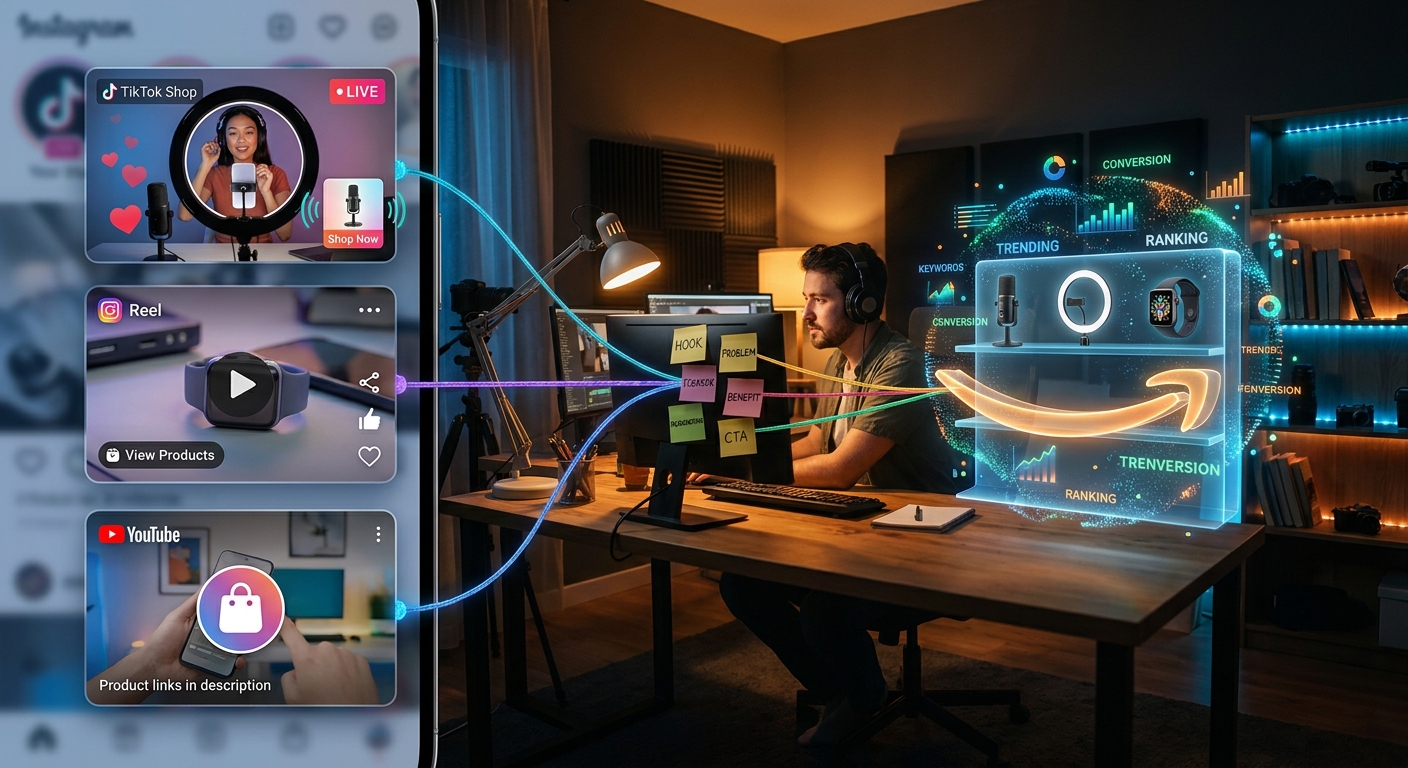
You are not imagining it. The same product video can do great on TikTok or Instagram, then send people to Amazon and somehow die on arrival. That is maddening, especially when your creative did its job and the clicks were real. The problem is that Amazon is no longer just the cash register at the end of the social journey. Inside the app, Rufus, Amazon’s AI shopping assistant, is now helping decide what shoppers compare, what questions they ask next, and which products get pushed back onto the shelf. So your video might be speaking one language on TikTok, Instagram, or YouTube, while your Amazon listing is speaking another. If those signals do not match, the customer gets rerouted. The fix is not more hype. It is tighter alignment. You need content and product pages that clearly say who the item is for, what problem it solves, and why someone should buy it right now.
⚡ In a Hurry? Key Takeaways
- Amazon Rufus can redirect shoppers after they arrive, so social content alone no longer guarantees Amazon sales.
- Start scripting every video and live stream around three matching signals: who it is for, what problem it solves, and why now.
- Do not overpromise in social clips. If the Amazon page cannot support the claim with titles, bullets, images, and reviews, conversions can fall fast.
What the “AI shelf hijack” really means
Creators keep asking the same question. Why did a video with strong watch time, solid comments, and good click-through suddenly stop converting on Amazon?
Because the handoff is no longer simple.
For a while, many sellers treated Amazon like a checkout page. A TikTok got attention. An Instagram Reel built interest. A YouTube Short explained the product. Then Amazon closed the deal.
Now Amazon has its own discovery brain inside the store. Rufus can answer shopper questions, compare products, suggest alternatives, and guide people toward items that better match the words and signals it sees. That means your social platforms and Amazon are each trying to interpret buyer intent in their own way.
If TikTok thinks your product is a dorm-room space saver, Instagram frames it as cute desk decor, YouTube presents it as a productivity tool, and Amazon lists it as generic office storage, you have a mismatch. Rufus may decide a different product fits the shopper better.
Why content that “works” on social can fail on Amazon
Social platforms reward attention first
TikTok, Instagram, and YouTube are very good at finding people who will stop scrolling. A dramatic before-and-after clip, a quick reaction, or a satisfying demo can pull in views even if the product positioning is still fuzzy.
That is enough to win reach. It is not always enough to win the sale on Amazon.
Amazon rewards clarity at the moment of purchase
Amazon shoppers are closer to buying. They ask practical questions. Is this the right size? Does it work for oily skin? Is it safe for pets? Does it fit in a carry-on? Can I use it with an iPhone 15?
Rufus is built for those questions. If your listing does not clearly answer them, Amazon’s own system may point the shopper toward another option that does.
Your message may be too broad
Many product videos try to appeal to everyone. That can help top-of-funnel reach, but it hurts platform alignment. Rufus works better when the product context is specific. “For runners with knee pain after long walks” is stronger than “great for everyone.”
How to optimize TikTok Instagram YouTube content for Amazon Rufus and social shopping
This is the core fix. Every piece of content should carry the same three signals across all platforms and your Amazon listing.
1. Who is this for?
Name the buyer plainly. New moms. Apartment renters. Frequent travelers. Teachers. People with curly hair. Dog owners with anxious puppies.
Do not bury this. Say it out loud in the first few seconds of the video. Put it in captions. Include it in product tags where possible. Make sure Amazon’s title, bullets, A+ content, and images back it up.
2. What problem does it solve?
Pick one main problem. Not five.
A good script is simple. “If your laptop charger keeps slipping behind the desk, this clip holds it in place.” That gives social algorithms context and gives Rufus cleaner signals too.
3. Why now?
This is the timing trigger. Back-to-school. Summer travel. Post-workout recovery. Small apartment clean-up. Holiday hosting. New puppy stage.
“Why now” helps on both sides. Social platforms get a clearer reason to show your content to the right crowd, and Amazon gets a stronger use-case signal for shopper questions and comparisons.
A simple scripting formula creators can use this week
You do not need to reinvent your whole content style. Just tighten the structure.
The 15-second short video script
Hook: “If you travel with tangled cables, you need to see this.”
Problem: “Mine used to get crushed and lost in my backpack.”
Demo: “This case keeps cords, charger blocks, and earbuds in separate spots.”
Why now: “Perfect if you are packing for summer trips or heading back to campus.”
Close: “It is linked in my shop and on Amazon.”
That script gives every system something useful. Audience. Problem. Use case. Product function.
The live stream version
In live shopping, repeat the same positioning every few minutes. New viewers join constantly.
Try this pattern:
“For anyone setting up a small apartment kitchen, this gadget saves counter space. The main thing it fixes is cabinet clutter. I started using it during a recent move, and that is why I am showing it today.”
Then answer real buyer questions in plain English. That language often mirrors the questions shoppers ask Amazon too.
What to change on Amazon so Rufus has better material to work with
If your content is aligned but the listing is vague, you still have a problem.
Rewrite titles and bullets for human questions
Do not stuff keywords and call it a day. Write bullets that answer the obvious buyer concerns.
Instead of:
“Premium ergonomic bottle, stylish design, durable material.”
Try:
“Made for commuters and gym users who want a leakproof bottle that fits most cup holders.”
That is clearer for both people and AI systems.
Use images that match your social promise
If your TikTok is about meal prep for busy parents, your Amazon images should show that use case. If your Reel targets dorm storage, your image stack should show a dorm-like setting, not a luxury office.
Mine reviews and questions for exact wording
Customers already tell you how they think about the product. Use their language. If reviews say “great for swollen feet after work,” do not rewrite that into bland marketing speak. That real phrasing is gold.
Platform-by-platform tips
TikTok Shop
TikTok responds well to problem-first hooks and fast visual proof. Open with the pain point. Show the fix immediately. Keep your spoken words consistent with your product title and on-screen text.
If you are sending traffic to Amazon instead of using TikTok Shop directly, make the transition feel natural. The shopper should expect to see the same use case on Amazon that they just saw in the clip.
Instagram shopping
Instagram is still more aesthetic, but the best shopping posts do not stop at pretty. Use carousels and Reels to show context. Who uses it. Where it lives. What annoyance it removes.
Product tags should connect to a page that feels familiar. If the Amazon listing looks generic compared with the polished Instagram post, trust drops.
YouTube shopping
YouTube gives you more time to explain. Use that advantage. Shorts can grab attention, but longer videos are great for buyer objections, side-by-side comparisons, and “best for” explanations.
If your YouTube audience is warmer and more research-driven, your Amazon page needs deeper answers. Think compatibility, sizing, cleaning, battery life, setup, and return concerns.
The biggest mistake social sellers are making right now
They are optimizing each platform in isolation.
One team writes punchy TikTok hooks. Another makes pretty Instagram posts. Another uploads YouTube demos. Then Amazon gets a half-finished listing written like a warehouse catalog.
That setup made more sense before Amazon’s in-app assistant started playing a stronger discovery role. Now the system is more connected. Mixed signals cost money.
The fix is to create one message spine for the product, then adapt it by format.
Your message spine should include:
- Primary audience
- Main pain point
- Top use case
- Seasonal or timely reason to buy
- Proof point, such as a demo, review theme, or comparison
A practical workflow for teams and solo creators
Here is a simple process that works whether you are a solo affiliate or a growing brand.
Step 1: Write one positioning sentence
Example: “This portable blender is for office workers and commuters who want quick protein shakes without using a full kitchen.”
Step 2: Build three short hooks from it
“If you skip breakfast because mornings are chaos…”
“For commuters who are tired of buying expensive smoothies…”
“If your office lunch never has enough protein…”
Step 3: Match the Amazon listing
Make sure the title, bullets, images, and FAQ reflect that same buyer and use case.
Step 4: Check the handoff
Click from your own social post to the Amazon page. Ask yourself one question. Does this feel like the same product story, or did the shopper just walk into a different store?
What success looks like after alignment
You may not get viral numbers overnight. But you should start seeing healthier patterns.
- Fewer empty clicks from social
- Better Amazon conversion on traffic that does arrive
- More relevant comments and questions
- Higher-quality shoppers who understand the product faster
- Stronger repeatability across TikTok, Instagram, YouTube, and Amazon
That is the goal. Not random spikes. A cleaner path from discovery to purchase.
At a Glance: Comparison
| Feature/Aspect | Details | Verdict |
|---|---|---|
| Social reach vs Amazon conversion | TikTok, Instagram, and YouTube can drive attention, but Rufus can still redirect shoppers if the Amazon listing lacks clear buyer and use-case signals. | Views are not enough. Alignment matters. |
| Best content strategy | Use one core message across all platforms: who it is for, what problem it solves, and why now. | This is the most practical fix. |
| Risk of ignoring Rufus | You may keep getting social engagement without Amazon sales, or Amazon purchases without building long-term social momentum. | Expensive mistake. Start adjusting now. |
Conclusion
Amazon is not just sitting there waiting to cash out your TikTok, Reel, or YouTube traffic anymore. Rufus is now part of the shopping journey, and it is shaping what customers see, compare, and choose once they enter Amazon. That means the old habit of treating Amazon like a simple checkout button is starting to break down. The good news is that this is fixable. If you start feeding Rufus and the social platforms the same clear signals about who the product is for, what problem it solves, and why now, your content and your listing can finally start working together. Do that, and you give TikTok Shop, Instagram product tags, YouTube shopping tools, and Amazon’s own AI shelf a better chance to push in the same direction instead of cancelling each other out.