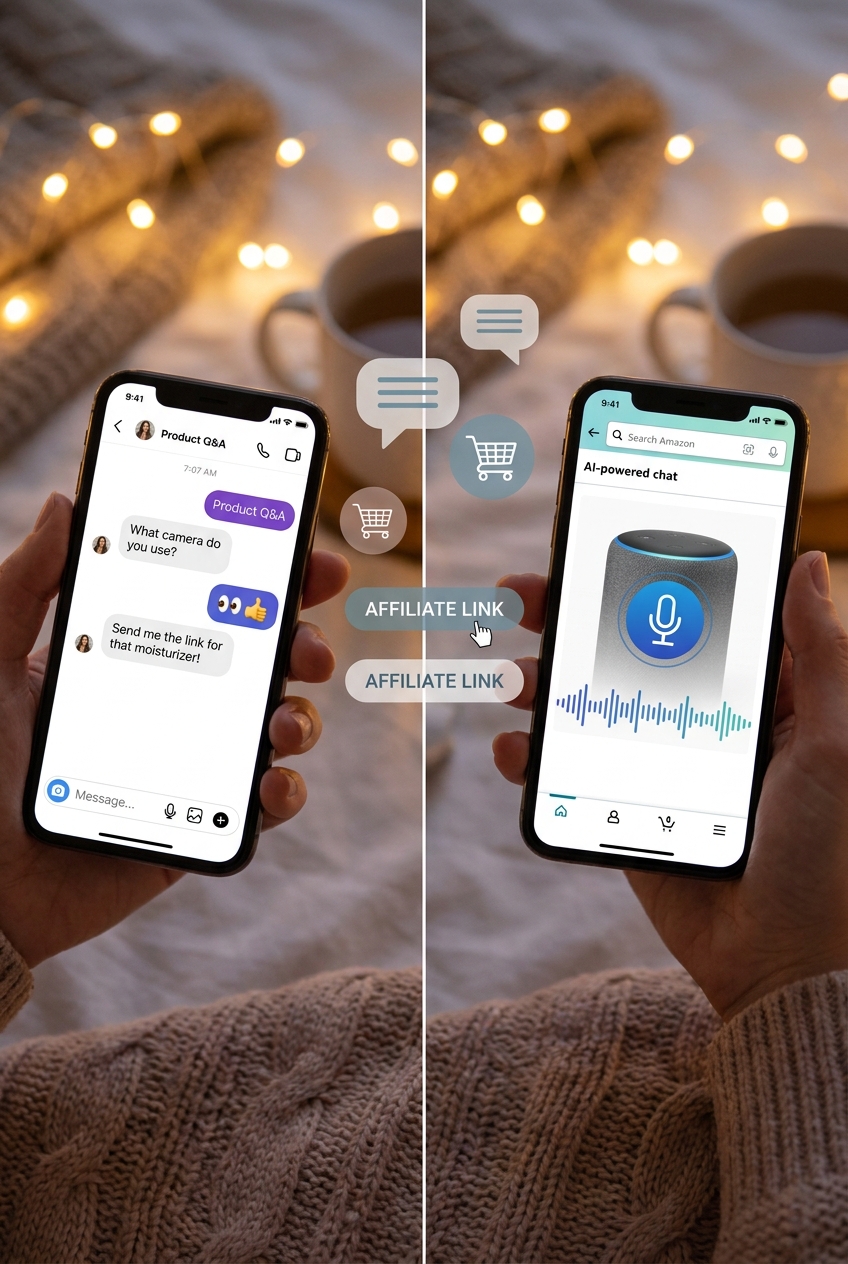
You know the feeling. A follower DMs you, asks which air fryer or skincare tool you actually use, you send the link, they say “thank you,” and then… nothing. A day later they buy it on Amazon after searching on their own, asking Amazon’s chat a few questions, or listening to a quick audio recap. You did the selling work. You may not get the credit. That is the real problem behind this new amazon influencer ai shopping chat strategy. Amazon is quietly training shoppers to make the final decision inside Amazon, not in your inbox. That sounds annoying, but it can also work in your favor. If your content and DMs are built to guide people into Amazon’s own question-and-answer flow faster, you stop acting like unpaid customer support and start acting more like the trusted shortcut that gets them to buy while your link still has a chance to track.
⚡ In a Hurry? Key Takeaways
- Amazon’s new chat and audio shopping tools are moving the “Should I buy this?” moment into the Amazon app, so creators need to send people there in a smarter way.
- Start scripting your videos and auto-replies around common DM questions, then push people to your product link while they are still in decision mode.
- Do not fight Amazon’s AI. Use it to speed up trust and reduce lost commissions from people who buy later after leaving your messages.
What the “Voice DM Cart” play actually means
This is not a formal Amazon feature name. It is a useful way to describe what is happening.
Your audience sees your TikTok, Reel, Short, or Story. They reply with a voice note, a screenshot, or a quick “link?” message. You answer. Then instead of needing a full back-and-forth with you, they jump into Amazon and let Amazon finish the job through AI chat, product summaries, reviews, and now audio highlights.
That last step matters a lot.
For years, creators were the product explainer, the objection handler, and the friend who said, “Yes, this one is worth it.” Now Amazon wants to become that friend too. Faster. At scale. Inside the app where checkout happens.
If you ignore that shift, more of your recommendations will turn into untracked, delayed purchases. If you adjust, you can make your content fit how people now shop.
Why this hurts creators and influencers
You are doing the convincing, but Amazon is doing the closing
This is the part that stings. Your video creates interest. Your DM reply handles the first question. But the final decision happens later when the follower is lying in bed, opening Amazon, and asking something like “Is this good for small kitchens?” or “How does this compare to Ninja?”
At that point, your original recommendation can get separated from the purchase path.
People do not shop in one straight line anymore
They discover on social. They save. They ask you. They check Amazon. They listen to product highlights. They read reviews. Then they buy later.
That means the old idea of “I posted a link, so I’m covered” is getting weaker.
This is part of a much bigger pattern across platforms. If you have been watching how social apps keep more discovery, messaging, and payment inside their own walls, this shift will feel familiar. We are seeing the same kind of behavior in The New ‘Super App Shuffle’: How TikTok’s Quiet Shopping, Messaging And Payments Push Could Rewrite Your Whole Sales Strategy. The platforms want fewer exits and faster decisions.
What Amazon’s AI shopping tools are changing
Chat-style product Q&A
Instead of making your follower wait for you to reply, Amazon can answer basic buying questions right away. Not perfectly, of course. But often well enough to keep the shopper moving.
That means your role changes from “answer every detail” to “get them to the right product page with confidence.”
Audio product highlights
Audio recaps are a sneaky big deal. A lot of people do not want to read long listings or scroll through endless reviews. If Amazon gives them a quick spoken summary, that lowers friction.
Less friction usually means faster decisions.
Decision-making inside the app
This is the biggest change. The question is no longer just, “Can I get them to click?” The question is, “Can I shape their buying path before Amazon’s own tools take over?”
How to adjust your amazon influencer ai shopping chat strategy
1. Build content around the exact DM questions you already get
Go through your inbox. Look for repeats.
You will likely find the same handful of questions:
- Is it worth the money?
- Is it good for beginners?
- What size should I get?
- What is better, this one or that one?
- Does it actually last?
Those are not just questions. They are buying triggers.
Make short videos that answer one question at a time. Then point viewers to the link with a simple line like, “If you want specs, reviews, and the latest price, check the product page here.”
That works better than trying to cram every answer into one caption or DM.
2. Stop treating DMs like the finish line
A DM is not the sale. It is the handoff.
That means your reply should do three things fast:
- Confirm the product is right for the person
- Answer one key objection
- Send them to the buying page while intent is still hot
Example reply:
“Yes, this is the one I’d pick if you want something easy and compact. It’s best for small kitchens and quick cleanup. Here’s the link I use so you can check the latest price and features.”
Short. Human. Useful.
3. Use voice notes and Stories as pre-sold bridges
If your audience already sends voice notes, meet them there. A quick spoken answer often feels more personal than a typed paragraph. It also matches the way people are now consuming product info through audio.
You are basically warming them up for the next step, which may be Amazon’s own spoken summary or chat assistant.
Think of your voice reply as the trust layer. Amazon handles the detail layer. Checkout handles the money layer.
4. Frame your recommendations like guided shopping, not hard selling
People get defensive when content feels pushy. They relax when it feels helpful.
Try language like:
- “If you’re comparing two options, start here.”
- “If your main concern is battery life, this is the one I’d look at first.”
- “If you just want the simple version, this is the safe pick.”
That style fits neatly with Amazon’s own AI tools, which are also trying to reduce confusion and speed up the decision.
5. Create “buying moment” content, not just review content
A review says what a product is like.
A buying moment piece answers why someone should act now.
Examples:
- “Three reasons people pick this over the cheaper version”
- “Who should skip this, and who should buy it”
- “What I wish I knew before ordering this on Amazon”
Those formats line up better with late-stage shoppers who are close to buying and just need a nudge.
How to reduce lost attribution
Use cleaner calls to action
“Link in bio” is fine, but it is lazy if that is all you say.
Tell people what they will get when they click.
Better examples:
- “Tap the link if you want to compare sizes and read the review highlights.”
- “I linked the exact model so you don’t end up on the wrong version.”
- “Use my link if you want the one with the features I showed here.”
That gives the click a purpose.
Reply fast to high-intent messages
Not every DM is equal. “Cute!” is not the same as “Which one should I buy?”
If someone is asking a direct purchase question, answer quickly. That is your best shot before they bounce into Amazon search and start over without your path.
Keep your product pages organized
If you are using influencer storefronts, idea lists, or themed collections, make them dead simple. A confused shopper wanders. A guided shopper buys.
Group products by use case, not by brand vanity.
Examples:
- Best small-apartment kitchen picks
- Beginner skincare tools I’d actually rebuy
- Travel gear under a certain budget
What not to do
Do not try to out-answer Amazon on every tiny detail
You will burn out. Also, that is no longer the highest-value use of your time.
Your job is trust, taste, and context. Amazon’s job is inventory, reviews, and checkout.
Do not send generic links with no framing
A bare link gives people no reason to click now instead of later. And “later” is when tracking often falls apart.
Do not ignore the way platforms are blending chat, shopping, and payments
This is not just an Amazon story. It is a commerce behavior story. The more platforms become all-in-one places to discover, ask, decide, and buy, the more creators need to design for handoffs, not just top-of-funnel attention.
A simple playbook you can use this week
- Pick your top 10 most-DM’d products.
- Write down the top 3 questions you get for each.
- Create short videos answering one question per clip.
- Set up saved replies for those same questions.
- End each reply with a clear reason to click your product link now.
- Use voice notes for warm, high-intent followers when it makes sense.
- Watch which questions lead to clicks and double down on those angles.
That is the practical version of an amazon influencer ai shopping chat strategy. Nothing fancy. Just better timing, better framing, and less wasted effort.
At a Glance: Comparison
| Feature/Aspect | Details | Verdict |
|---|---|---|
| Amazon AI chat | Answers product questions quickly inside Amazon, often before a creator can reply in DMs. | Useful if your content sends shoppers there with confidence instead of making them search from scratch. |
| Audio product highlights | Gives shoppers a faster, lower-effort way to understand a product without reading long listings. | Good for conversion speed, but it means creators must hook intent earlier. |
| DM-to-link handoff | Your reply becomes the bridge from social curiosity to Amazon’s guided shopping flow. | Best place to protect trust and reduce “I bought it later” commission loss. |
Conclusion
This shift is frustrating, but it is also very clear. Amazon is pouring AI into how people actually make decisions inside the app, from chat-style Q&A to audio product recaps, and that is exactly where your audience’s “Should I buy this?” moment is moving. If you learn to frame your TikToks, Reels, Shorts and Stories around DM conversations that hand off to Amazon’s own guided shopping flows, you keep trust, speed up decisions and finally stop losing attribution on all those late-night “I grabbed it later” purchases. You do not need to fight the change. You just need to meet your followers one step earlier, and send them forward more intentionally.