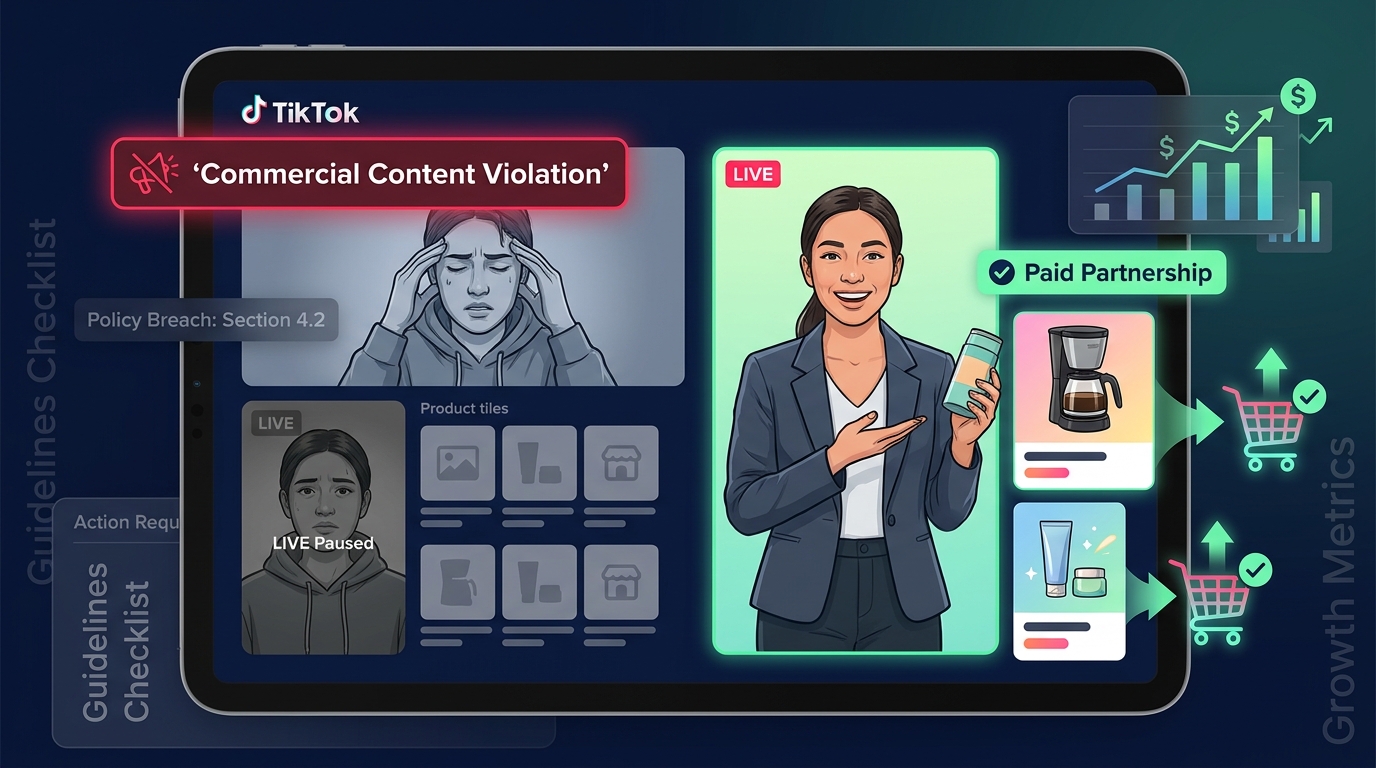
You did everything “right.” You found a winning product, got a creator to post, maybe even saw a few strong TikTok Shop sales. Then reach suddenly drops, a LIVE loses steam, or a listing gets flagged out of nowhere. That is the maddening part. For a lot of small brands and creators, the problem is not the product. It is the label. TikTok’s rules around commercial content have tightened, and the old habit of treating disclosure like a boring little checkbox is now risky. More than that, it is expensive. The smart play now is to treat tiktok commercial content disclosure tiktok shop as part compliance tool, part conversion tool. Done badly, it can hurt reach. Done cleanly, it can build trust, protect your catalog, and keep your best posts shoppable. If you sell through TikTok Shop, this is no longer back-office admin. It is part of performance marketing.
⚡ In a Hurry? Key Takeaways
- Yes, you should turn on TikTok’s commercial content disclosure whenever a post promotes a product or service, especially for TikTok Shop content.
- Use short, natural disclosure language at the start of videos, in captions, and during LIVE so you stay compliant without killing watch time.
- A missing toggle, sloppy claim, or unclear brand mention can reduce visibility or put products and accounts at risk, so audit your recent posts now.
The quiet rule change that is hitting creators
TikTok has become much stricter about sponsored and promotional content. If a creator is promoting a product or service, the platform now expects that post to be clearly disclosed as commercial content. That includes many TikTok Shop posts, affiliate videos, seeded products, gifted items, paid brand deals, and a lot of “I’m just sharing what I use” content that is not as casual as people think.
The trouble is that many creators still think disclosure is only for obvious paid ads. It is not. If there is a commercial relationship, a product push, or a clear selling intent, TikTok may expect disclosure. And if the platform decides you skipped it, the fallout can be annoyingly uneven. One post may slide by. Another may lose reach. A third may trigger a policy warning.
Why this matters more for TikTok Shop than regular posting
TikTok Shop is where loose habits become expensive fast. On normal social content, a weak disclosure habit might just create trust issues. On Shop content, it can affect discoverability, affiliate relationships, product listings, and even whether your content keeps getting distribution.
Shop content is already under a microscope
TikTok Shop has its own policy layers around product claims, prohibited items, misleading before-and-afters, health promises, counterfeit concerns, and brand misuse. Add commercial content disclosure to that stack, and one “small” mistake can become part of a bigger pattern.
That is why some sellers feel like they are being punished for random things. It often is not random. It is cumulative. A missed disclosure toggle plus a pushy claim in the caption plus a sketchy-sounding LIVE script can create a much bigger compliance problem than any single issue on its own.
LIVE momentum is fragile
LIVE selling depends on trust and momentum. If viewers feel like they are being sold to in a sneaky way, they bounce. If TikTok’s systems detect policy issues, momentum can stall for more technical reasons too. Either way, disclosure is not the enemy of conversion. Hidden selling is.
The new mindset: disclosure is now part of conversion
This is the piece a lot of brands miss. Clean disclosure does not just protect you. It can actually help sales.
Why? Because buyers on TikTok are not stupid. They know creators make money. They know affiliates earn commission. They know some products are gifted or sponsored. What makes them leave is not the sale itself. It is feeling tricked.
A clear disclosure can do three useful things at once:
- It shows confidence. You are not hiding the relationship.
- It sets honest expectations. That reduces the “wait, is this a secret ad?” reaction.
- It gives your content a cleaner compliance trail, which helps keep your selling machine running.
That is why I call this the disclosure boost play. Not because labels magically increase reach, but because proper labeling helps preserve trust, reduce risk, and keep winning content alive longer.
When you should turn on TikTok commercial content disclosure
If you are unsure, use the safer rule: if the content is selling, promoting, endorsing, or benefiting a product or service in a business context, disclosure probably belongs there.
Turn it on for these common cases
- Paid brand partnerships
- Affiliate posts with TikTok Shop links
- Gifted products when the post is promotional
- Creator videos made for a brand’s campaign
- LIVE sessions featuring products for sale
- Posts where you make claims meant to drive a purchase
Do not rely on “but I wasn’t paid” as your defense
This is where people get tripped up. If you got free product, earn commission, have a formal relationship, or are clearly promoting something for commercial gain, “not technically paid” may not save you. TikTok and regulators usually care more about the nature of the promotion than your personal definition of sponsorship.
How to disclose without sounding like a robot
A lot of creators avoid disclosure because they think it kills the vibe. It does not have to. The trick is to make it plain, short, and natural.
Good short disclosure examples for video
- “This is a TikTok Shop affiliate find I’ve been testing.”
- “Quick heads-up, this product was gifted, and here’s what I actually think.”
- “Paid partnership, but I asked to show the parts I like and the parts I don’t.”
- “I earn a commission if you buy through my link, so let me show you who this is really for.”
Good short disclosure examples for captions
- “TikTok Shop affiliate.”
- “Paid partnership with [Brand].”
- “Gifted item. Honest review.”
- “Commission may be earned from purchases.”
Notice what these do. They disclose the relationship quickly, then move straight into useful information. That is the sweet spot.
What not to do
- Hide disclosure at the very end of a long caption
- Use vague tags nobody understands
- Say “not sponsored” when there is still an affiliate or gifting relationship
- Make the disclosure clear but the claims sloppy
The bigger risk is often the script, not just the toggle
Plenty of creators remember to flip on the label and still get into trouble because the actual content is too aggressive. TikTok Shop has become less forgiving about misleading claims, especially in categories like beauty, wellness, supplements, and products with dramatic “results.”
High-risk phrases to clean up
- “Guaranteed results”
- “Cures” or “heals” for health-related products
- “Everyone needs this”
- “Official” brand language if you are not the brand
- “Best on TikTok” unless you can prove it
Safer replacements
- “Here’s what it did for me”
- “This may help with”
- “Popular for people who want”
- “Compatible with” instead of pretending to be the brand
- “One of my top picks”
That small wording shift matters. It keeps your content sounding human while lowering your chance of being tagged for misleading promotion.
A simple audit for your last 20 TikTok Shop posts
If you only do one thing after reading this, do this audit. Open your last 20 product-related posts and check each one against four questions.
1. Was the commercial relationship obvious?
If the answer is no, add better caption language going forward and make sure the proper disclosure setting is on.
2. Did the spoken script make risky claims?
Listen for anything that sounds absolute, medical, deceptive, or overhyped.
3. Did the caption match the actual relationship?
“Honest review” is not enough if it is also affiliate content or a paid post.
4. Was the product, brand, or listing described accurately?
Make sure you are not implying official brand status, fake scarcity, impossible results, or features the item does not really have.
Score each post green, yellow, or red.
- Green: clear disclosure, clean claims, accurate product info
- Yellow: one fix needed, usually caption or wording
- Red: missing disclosure, risky claims, or misleading presentation
If you find more than a few red posts, do not panic. Just stop guessing and create a standard process.
The best brands will stop “winging it” with affiliates
This is where Q3 winners will separate themselves. Brands that work with creators need clear rules, not vibes.
Give creators a one-page disclosure playbook
It should include:
- When to turn on commercial content disclosure
- Approved caption examples
- Words and claims to avoid
- How to refer to the brand correctly
- LIVE talking points that stay compliant
Agree on who is responsible for what
Do not assume the affiliate “already knows.” Put it in writing.
- Who turns on the disclosure toggle?
- Who checks caption language?
- Who approves product claims?
- Who reviews old content if a policy warning appears?
That may sound basic, but basic systems prevent messy takedowns.
Why honest labels can actually help sales
There is a funny thing about social commerce. The more direct you are, the less weird the selling feels.
A creator who says, “I earn a commission on this, and here is what I like and don’t like,” often sounds more believable than one acting like they just accidentally discovered the greatest product ever made.
That honesty reduces buyer friction. It also improves comment quality. Instead of “is this an ad?” you get questions like “does it work on oily skin?” or “how long does shipping take?” Those are buying questions. That is where you want the conversation.
Your practical template for safer TikTok Shop posting
For short videos
Hook: “If you’ve been looking for a lightweight travel steamer, this one surprised me.”
Disclosure: “This is a TikTok Shop affiliate item, so I may earn a commission if you buy.”
Value: “Here’s what it does well, and one thing I wish were better.”
CTA: “If you want the exact one, it’s linked here.”
For gifted product content
Hook: “I got sent this to test, and I expected it to be gimmicky.”
Disclosure: “It was gifted to me, but this is my real take.”
Value: “Best feature first. Biggest drawback second.”
CTA: “If it fits what you need, check the details before you buy.”
For LIVE
Open with a plain disclosure early in the stream. Repeat it naturally when new viewers pile in. Keep claims grounded. Focus on demos, use cases, sizing, ingredients, setup, shipping, and who the product is for. That kind of detail sells better anyway.
At a Glance: Comparison
| Feature/Aspect | Details | Verdict |
|---|---|---|
| Missing disclosure | Can create trust problems, lower visibility, and increase policy risk for TikTok Shop posts and LIVE content. | High risk. Fix immediately. |
| Clear, short disclosure | Sets expectations fast, supports compliance, and often makes the recommendation feel more honest. | Best practice. Use every time commercial intent exists. |
| Overhyped claims | Even with the right toggle on, exaggerated health, beauty, or performance claims can still trigger violations. | Unsafe. Rewrite scripts and captions. |
Conclusion
TikTok has tightened its rules around commercial content and branded promotion, and the platform is making it much clearer that creators should use disclosure when they promote a product or service. At the same time, TikTok Shop is getting stricter about misleading claims, brand usage, and e-commerce violations. That means a lazy caption, a missing toggle, or a too-good-to-be-true script can do real damage. The good news is this is fixable. The creators and brands who win in Q3 will not be the ones playing cute with labels. They will be the ones with clean disclosure habits, repeatable caption templates, safer LIVE scripts, and crystal-clear agreements about who handles compliance. Start with your last 20 posts. Clean up the risky ones. Build a simple checklist. If you do that, you are not just staying out of trouble. You are making your TikTok Shop content more trustworthy, more stable, and a lot more likely to keep converting while the rules keep shifting.