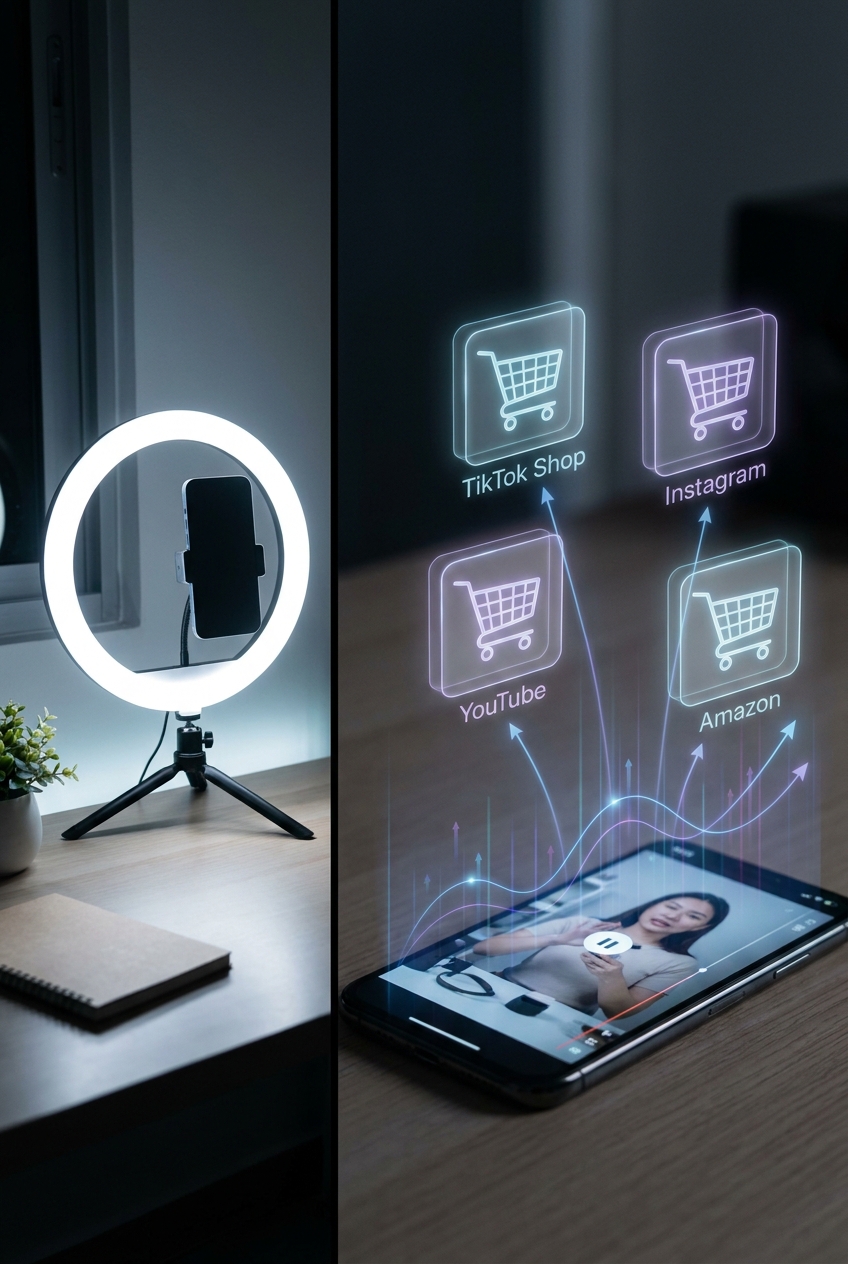
You post one product video, then the platform chaos starts. TikTok Shop wants a native offer. Instagram wants tagged products in a Reel. YouTube wants shopping links and product tags. Amazon wants fresh storefront clips and creator picks. If you are a solo creator or small brand, it can feel like four part-time jobs fighting over the same 30 seconds of content. That is the real appeal of the new multi-cart stack. It is not about doing more. It is about making one piece of content work in more than one checkout lane at the same time.
If you are wondering how to sell on TikTok Shop Instagram YouTube and Amazon with the same content, the answer is simpler than it sounds. Build one “source” video, then adapt the packaging around it. Keep the hook, demo and proof the same. Change the links, tags, captions and product mapping for each platform. The video stays mostly intact. The cart changes. Done right, you stop rebuilding your sales system every time one app changes the rules.
⚡ In a Hurry? Key Takeaways
- Yes, you can sell on TikTok Shop, Instagram, YouTube and Amazon with the same core content if you swap the checkout path for each platform.
- Start with one strong vertical video, then create platform-specific versions with the right product tags, links, captions and calls to action.
- Do not let any one platform own your whole business. A multi-cart stack gives you backup when reach drops or commissions change.
What the “multi-cart stack” actually means
Think of it like this. You are not making four different sales campaigns. You are making one content asset that can feed four different carts.
The stack usually looks like this:
- TikTok Shop for fast discovery and impulse buys
- Instagram Shopping or affiliate links for people who already follow you
- YouTube Shopping tags for longer shelf life and search traffic
- Amazon Influencer or storefront links for high-intent buyers who trust Amazon checkout
Each platform plays a different role. TikTok finds people. Instagram warms them up. YouTube keeps working after the trend fades. Amazon closes people who want Prime shipping and familiar checkout.
That is why creators are quietly moving this way. They are tired of betting the whole month on one app.
Why creators are doing this now
Because the old way is exhausting.
You make one TikTok. Then someone tells you it should have been an Instagram Reel. Then YouTube says Shorts with product tags are getting pushed. Then Amazon wants updated idea lists, video reviews or storefront clips. Every platform acts like it should be your main job.
But for most people, there is no extra team hiding in the back room.
The multi-cart stack is a survival move. It gives you a way to reuse the expensive part, your idea, your filming time, your face on camera, your product demo, and only change the last-mile pieces.
How to sell on TikTok Shop Instagram YouTube and Amazon with the same content
1. Start with a “master video”
Create one clean vertical video first. Aim for 20 to 45 seconds for most products. Include three things:
- A fast hook in the first two seconds
- A simple demo or before-and-after moment
- A clear reason to buy now
Example. If you are selling a kitchen gadget, your master video might be:
- Hook: “I thought this was pointless until it cut prep time in half.”
- Demo: Show the product solving one annoying problem
- Proof: Show the result, then mention the exact item
Keep branding light. Do not overstuff it with platform-specific language yet.
2. Make four versions, not four new videos
This is the key shift.
You are not starting from scratch for each app. You are making light edits:
- TikTok Shop version: Native product anchor, TikTok-style caption, a direct CTA like “grab it here”
- Instagram version: Product tag in Reel, cleaner caption, maybe slightly more polished cover image
- YouTube version: Product tag or linked product shelf, searchable title, maybe a spoken phrase that works without trend context
- Amazon version: Use the same clip in your storefront or product review content, but trim out references to other platforms
The core footage can stay almost identical. The wrapper changes.
3. Match the call to action to the platform
This is where many creators mess it up.
A TikTok CTA can be quick and impulse-driven. Instagram often needs a softer prompt. YouTube rewards clarity. Amazon content works better when it feels useful, not salesy.
Here is a simple guide:
- TikTok Shop: “It’s linked in the product tab.”
- Instagram: “Tap the product tag if you want the exact one.”
- YouTube: “I tagged the product so you can check specs and price.”
- Amazon: Focus on what the product does, then let the storefront handle the conversion
Same video. Different final nudge.
4. Keep one product naming system
This sounds boring. It will save your sanity.
If the same item is called “Mini Blend Pro” on TikTok, “Portable Blender” on Instagram, and “USB Smoothie Mixer” on Amazon, your reporting turns into a mess. Use one master product name in your own spreadsheet, even if the public listing titles differ a bit.
Track:
- Product name
- SKU or ASIN
- TikTok Shop listing
- Instagram tagged product
- YouTube linked product
- Amazon storefront or product link
This helps you see which content concept is working, not just which app had a lucky week.
The practical workflow that keeps this manageable
If you want this to work without eating your whole week, use a batch system.
Record once
Film three to five master videos in one session.
Edit once
Create a clean version with captions burned in, but leave room for each app’s native product tools.
Package four times
Export platform-specific versions with the right caption, cover, product tag and link structure.
Review weekly
Check which angle is selling, problem-solving demo, testimonial style, unboxing, comparison, and then roll that angle into the next batch.
This is also where it pays to be careful about handing everything to a managed service. The promise sounds lovely when you are tired, but if someone else controls your creator mix, ad logic and store operations, you can slowly lose touch with what actually makes your audience buy. That is why it is worth reading The New ‘Managed Shop Trap’: Why TikTok’s Done‑For‑You Storefronts Could Quietly Train You Out Of Your Own Business. It makes an important point. Convenience can train you out of your own sales instincts.
What changes on each platform, and what should stay the same
What should stay the same
- The product being featured
- The core hook
- The proof or demo
- The overall promise of the video
What should change
- Caption style
- Product tags or anchors
- Thumbnail or cover text
- Disclosure language for affiliate content
- Platform-specific CTA
This is the part many people get backwards. They rewrite the whole video, then forget to fix the metadata that actually controls the shopping path.
Common mistakes that wreck a multi-cart stack
Using a TikTok-native joke everywhere
Some jokes or sounds travel badly. A clip built entirely around one TikTok trend can feel stale on YouTube a week later.
Forgetting the checkout experience
Amazon buyers often want specs, ratings and delivery confidence. TikTok buyers often want speed and excitement. Same product, different buying mood.
Sending all traffic to one platform out of habit
If your content is doing well on Instagram but your caption tells everyone to “go to TikTok,” you are creating friction for no reason.
Not saving your raw footage
Always keep the clean files. Platforms change dimensions, product features and edit styles constantly. Raw footage is insurance.
Ignoring compliance and disclosures
If something is affiliate content, say so clearly where needed. Boring, yes. Still important.
Who benefits most from this approach
This works especially well for:
- Solo creators who do not have an editor for every platform
- Small brands working with a tiny content budget
- Amazon Influencers who want more top-of-funnel discovery
- TikTok Shop sellers who are nervous about relying on one app
- Creators with evergreen products that solve clear problems
If your product needs a lot of explanation, YouTube may carry more weight. If it is visually obvious and impulse-friendly, TikTok Shop may bring the first sale. The point is not equal effort on every platform. The point is connected effort.
At a Glance: Comparison
| Feature/Aspect | Details | Verdict |
|---|---|---|
| Content creation workload | One master video gets lightly adapted for four shopping systems instead of filming four separate campaigns. | Best way to save time without going silent on other platforms. |
| Platform risk | If TikTok reach drops or one commission program changes, the same content can still earn through Instagram, YouTube or Amazon. | Much safer than building your whole business on one app. |
| Setup complexity | You need product mapping, clear naming, platform-specific tags and a repeatable workflow. | A little fussy at first, then much easier once your system is built. |
Conclusion
The social commerce race is speeding up faster than most solo creators and small brands can reasonably handle. That is exactly why the multi-cart stack matters. It gives you a calmer way to work. Instead of chasing every new shopping feature like it is a separate career, you build one strong piece of content and let it feed TikTok Shop discovery, Instagram native shopping, YouTube Shopping tags and Amazon conversions together. When one platform throttles reach, changes commissions or shifts priorities, you are not back at zero. You still have working rails elsewhere. That is the real win here. Not more hustle. More resilience, from the same content you were already making.