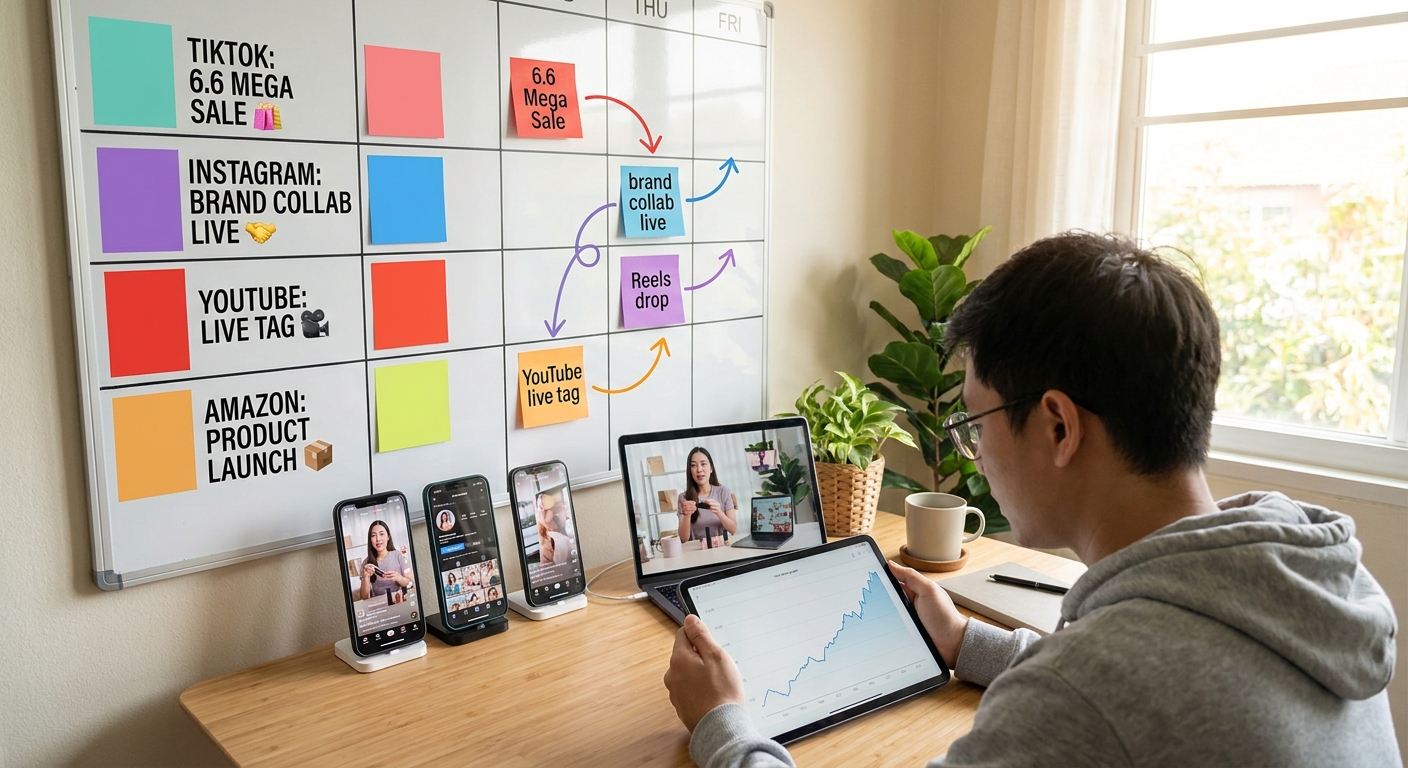
If you sell online or make shopping content, the promo calendar is starting to feel a bit ridiculous. One week it is TikTok’s 6.6 Birthday Mega Sale. Next week Instagram wants live shopping pushes. Then Amazon throws in Prime-style urgency. Every platform says its event is the one you cannot miss. That is exhausting when you are a solo creator, a tiny brand, or both. You still have to make content, answer customers, pack orders, watch margins, and somehow keep your sanity.
The big shift is this. TikTok Shop’s 6.6 sale was not just another flashy promo. It showed how social shopping is moving toward event days that reward people who can prepare early, go live often, and post with purpose. That can work very well if you have a plan. If you do not, these sales quietly eat your time, your stock, and your energy. The good news is you do not need to join every event. You need a repeatable system that helps you pick the right ones, prep once, and reuse your best work across platforms.
⚡ In a Hurry? Key Takeaways
- TikTok’s 6.6 results matter because they confirm that shopping is becoming event-driven, and creators and small brands need a real calendar, not last-minute scrambling.
- Start with a simple rule. Pick only the promo days that fit your audience, your stock, and your energy, then reuse one campaign across TikTok, Instagram, YouTube, and email.
- Do not chase every sale. Protect your margins, avoid overpromising inventory, and treat burnout as a business cost, because it is one.
Why TikTok’s 6.6 sale changed the game
TikTok Shop says its 6.6 Birthday Mega Sale delivered record-breaking performance, with strong jumps in shoppers, livestreams, and gross merchandise value. That is the part the headlines like.
The more important part is what it teaches smaller sellers and creators. Platforms are training shoppers to show up on specific dates, expect deals, and buy fast. That means these sales are no longer random opportunities. They are becoming part of a retail rhythm.
For big brands, that is manageable. They have staff, budget, and backup stock. For smaller players, it can feel like running a marathon every other weekend.
And it is not just TikTok. Meta keeps adding shopping and affiliate tools. YouTube is pushing Shopping harder too. So the social shop calendar is getting crowded, and the pressure to “show up hard” is spreading across every app where people can watch, click, and buy.
The real problem is not the sale. It is the stacking.
Most creators and small brands can survive one big event. What wears them down is the stack of tasks around it.
What gets stacked up
You need teaser content before the event. Live content during it. Follow-up content after it. Then there is pricing, coupons, affiliate links, product tagging, inventory checks, customer support, shipping prep, and returns.
Now repeat that for TikTok, Instagram, YouTube, and maybe Amazon.
That is why a smart tiktok shop 6.6 sale strategy for creators and brands is not really about one day. It is about building a system that can survive many sale days.
Do not ask, “Should I join?” Ask, “What kind of event is this?”
Not every sales event deserves the same effort. A lot of burnout comes from treating all promos like make-or-break moments.
Put each event into one of three buckets
Bucket 1: Core event. This is a sale you plan around. Your audience is active there. Your products fit the platform. You have enough stock and enough content ideas. TikTok 6.6 might be in this bucket for a beauty creator or gadget brand already doing well with short videos and live selling.
Bucket 2: Support event. You show up, but lightly. Maybe one live, three clips, and an email. Enough to be present, not enough to wreck your week.
Bucket 3: Skip event. This one is important. If the audience is weak, margins are thin, or your team is tired, skip it. Missing one noisy promo is better than damaging the next three weeks.
Your cross-platform promo calendar should be boring
That is a compliment.
The best calendar is not fancy. It is clear enough that you can look at one month and instantly know what needs to happen.
What to include
Build a simple sheet with these columns:
- Event name
- Date range
- Platform
- Goal, revenue, new followers, email signups, or stock clearance
- Main offer
- Hero product
- Content deadline
- Live date and time
- Inventory check date
- Post-event review date
If you want one rule that saves stress, use this one. No sale goes on the calendar unless it has a clear goal and a clear product focus.
A reusable playbook beats constant reinvention
You do not need a brand new campaign for every event. You need a repeatable framework.
The 5-part sale playbook
1. Pick one hero product or one tight product bundle.
Do not promote ten things at once unless you have a team. One hero item is easier to explain, easier to clip into short videos, and easier for viewers to remember.
2. Make three pre-sale assets.
Create one teaser video, one product demo, and one urgency post. Those can be cut and reposted across TikTok, Reels, Shorts, Stories, and email.
3. Plan one live session with a job.
Do not just “go live.” Decide the purpose. Is it for demos, FAQ answers, bundle upsells, or limited-time codes? A live with a clear job usually converts better than a long ramble.
4. Prepare a post-sale follow-up.
Most people forget this part. Post customer reactions, restock notices, and “best sellers from the event” clips. The sale may be over, but the buying mood often lingers.
5. Review the numbers quickly.
Within 48 hours, note what sold, what content got clicks, what time the live worked best, and where profit was better than expected. You are not just running a sale. You are collecting lessons for the next one.
How to decide if TikTok should get your biggest effort
TikTok is powerful for event commerce because shoppers are comfortable discovering products fast and buying inside the app. But that does not mean TikTok deserves your whole budget every time.
Give TikTok the lead when these are true
- Your product needs a quick visual demo
- Your audience already responds to short-form video
- You can commit to at least one strong live stream
- Your margins can handle discounts, creator commissions, or platform fees
Pull back when these are true
- Your product needs a long education cycle
- You are already low on stock
- Your support inbox is overloaded
- Your best sales still come from email, search, or repeat customers
The trick is not to be loyal to the platform. Be loyal to your numbers.
Content planning that does not eat your whole life
A lot of people burn out because they make platform-first content instead of campaign-first content.
Try this instead. Start with one sales message, then adapt it.
Example campaign flow for one event
Day minus 7: teaser clip, “something special is coming”
Day minus 5: problem-solution demo
Day minus 3: creator or customer proof
Day minus 1: reminder with offer details
Event day: live stream plus short clips from the live
Day plus 1: “what sold fastest” recap
Day plus 3: restock or waitlist post
That is one campaign. Not seven separate creative crises.
Inventory is where good sale ideas go to die
This is the least glamorous part, and maybe the most important.
If TikTok pushes a sale hard and your content lands, stock can disappear faster than expected. That sounds like a nice problem until refunds, angry comments, and late shipping start piling up.
Three inventory rules for event sales
Keep a buffer. Do not list every last unit if you know other channels may sell too.
Choose event-safe products. Feature items you can restock or substitute more easily.
Write your fallback now. Have prewritten text for delays, restocks, alternatives, and waitlists.
Small brands often focus so hard on getting demand that they forget demand can become chaos.
Protect your margins before you protect your pride
Social shopping creates a weird kind of pressure. If everybody else is running deep discounts, it is easy to feel cheap or invisible unless you match them.
Do the math first.
Check these before any sale goes live
- Discount amount
- Platform fees
- Affiliate or creator commission
- Shipping cost
- Packaging and returns
- Ad spend, if any
If the event only works when you sell at a painful margin, it may not be a real win. You are allowed to offer a bundle, bonus gift, or limited perk instead of a huge price cut.
A practical tiktok shop 6.6 sale strategy for creators and brands
Here is the simple version you can actually use.
For creators
- Pick products you can explain naturally in your own voice
- Batch sale content one week early
- Use one live, not five weak ones
- Track conversion by product type, not just views
- Save your best hooks and reuse them next event
For small brands
- Choose one hero SKU and one bundle
- Give creators simple talking points and clear commission terms
- Check stock before the promo, not during it
- Use TikTok as the event engine, then retarget through email and other channels
- Review profit by channel after the event, not just gross sales
For teams of one
- Cap the number of sale events you do each month
- Reuse thumbnails, scripts, captions, and offer graphics
- Schedule recovery time after the event
- Say no earlier than feels comfortable
What to watch as Q3 and Q4 heat up
The second half of the year is where this gets serious. More shopping tools, more platform promos, more overlapping campaigns, more pressure to be always on.
That is exactly why now is the time to build your system. By Q4, the people who look calm are usually not working less. They are repeating a process they already tested in smaller events like 6.6.
If you can make one event work cleanly, you can scale that method into back-to-school, holiday drops, and end-of-year pushes without reinventing your entire business every time.
At a Glance: Comparison
| Feature/Aspect | Details | Verdict |
|---|---|---|
| Event selection | Split promos into core, support, or skip based on audience fit, stock, and available time. | Best way to avoid chasing every noisy sale. |
| Content workload | Build one campaign with reusable teaser, demo, urgency, live, and follow-up assets. | Much more sustainable than making fresh content for each platform. |
| Profit protection | Check fees, discounts, commissions, shipping, and returns before joining any event. | Critical. High sales can still be bad business if margins collapse. |
Conclusion
TikTok Shop’s 6.6 Birthday Mega Sale matters because it confirmed something bigger than one successful shopping event. Social commerce is settling into a cycle of promo days that reward speed, prep, and consistency. That can be great news if you are ready for it. It can be brutal if you try to muscle through every platform’s “biggest ever” moment without a plan. With Meta pushing deeper into live commerce, and YouTube investing harder in Shopping, the calendar will only get busier from here. So the win is not joining everything. The win is building a cross-platform promo calendar, choosing the right events, and using a reusable playbook that protects your time, stock, and margins. Do that now, before Q3 and Q4 get noisy, and you will have a much better shot at riding these mega sales instead of getting flattened by them.