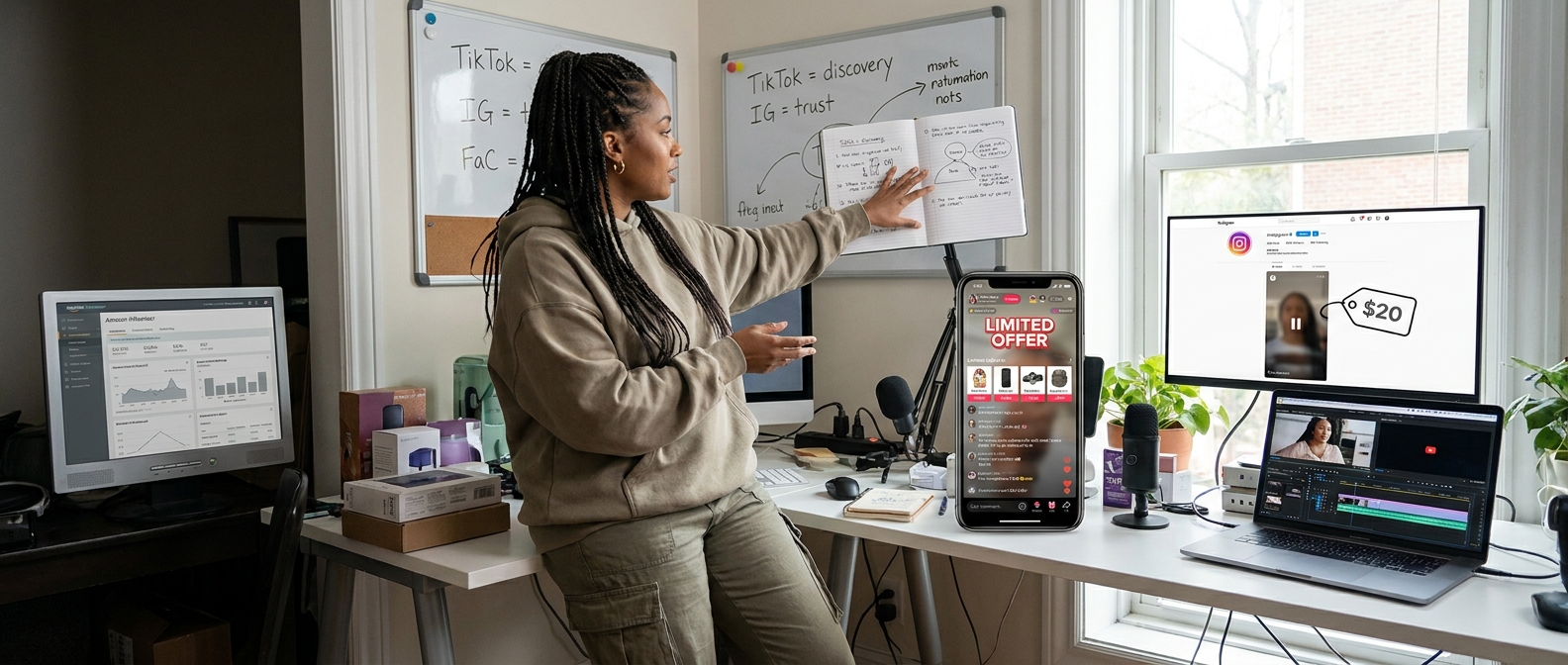
If you are an Amazon Influencer creator watching your dashboard go sideways, you are not imagining it. A lot of people who once counted on steady product video income are now seeing flat views, weaker commissions and reporting that feels almost useless when you are trying to figure out what actually sold. That is a rough place to be, especially if you built a whole posting routine around Amazon product pages. Meanwhile, TikTok Shop, Instagram Shopping and YouTube Shopping are getting better at the one thing creators care about most. Turning attention into checkout. Not someday. Right now. The shift matters because social commerce is no longer just about posting affiliate links and hoping. The platforms winning in 2026 are the ones that connect discovery, trust and buying in one smooth path. If you are comparing the Amazon influencer program vs TikTok Shop and Instagram shopping, the smarter move is no longer picking one. It is knowing what each platform is actually good at.
⚡ In a Hurry? Key Takeaways
- Amazon still works for some evergreen product searches, but many creators are moving new effort to TikTok Shop, Instagram and YouTube because discovery and sales tracking are clearer.
- Use Amazon for high-intent review content, TikTok for fast-converting demos, Instagram for brand trust and repeat exposure, and YouTube for deeper buying guides.
- Do not put your whole income on one platform. Split your catalog and test content by channel so one algorithm change does not wreck your month.
Why creators are pulling back from Amazon Influencer
Amazon still has one giant advantage. People go there ready to buy. That part has not changed.
What has changed is the creator experience around it. Many smaller influencers say the program feels less predictable than it used to. They are posting product videos, doing all the right things, and still ending up with earnings that seem random. Worse, the reporting often does not tell a clear story about which video, product or placement actually drove the sale.
That matters more than people think. If you cannot see what is working, you cannot improve. You just keep posting into the dark.
The dashboard problem is bigger than it looks
For non-creators, this may sound minor. It is not. Good reporting is basically a map. Without it, creators cannot tell whether a skin care demo, a kitchen gadget short or a tech accessory comparison is worth making again.
When reporting gets muddy, creators start guessing. Guessing leads to wasted time. Wasted time turns into burnout fast.
Flat traffic and shrinking commissions are pushing people to diversify
Some creators built solid side income on Amazon by making straightforward review clips for product pages. That model worked best when enough shoppers saw those videos and commissions felt stable. Now, many are finding that the same amount of work brings back less money.
That does not mean Amazon is dead. It means it is no longer the safe default it once felt like for a lot of mid-size and small creators.
Why TikTok Shop is pulling creators in
TikTok understands impulse buying better than almost anyone right now. A short, useful video can move a product from “never heard of it” to “ordered” in under a minute.
That is the core appeal. Discovery and checkout live much closer together.
It rewards content that feels native, not polished
Amazon product videos often feel like shelf content. Helpful, yes. But limited. TikTok gives creators more room to build a story around the item. Before-and-after clips, fast demos, “three things I hated and one thing I loved,” problem-solution hooks. That style tends to travel farther.
You do not need a studio. You need a believable reason for someone to care.
TikTok Shop gives creators stronger commerce signals
Creators like TikTok Shop because the platform is built to push products through content, not just attach content to a product listing. That sounds subtle, but it changes everything.
Instead of hoping a shopper stumbles onto your Amazon page video, TikTok can push your content out first and then create buying intent. For many sellers and creators, that means better conversion momentum on low- to mid-priced items, trend products, beauty, home, fashion and problem-solving gadgets.
Why Instagram Shopping is quietly becoming more useful again
Instagram is not as chaotic as TikTok, and that is actually part of the appeal. If TikTok is the fast-moving street market, Instagram is the nicer showroom where people come back to look twice.
For creators, that makes it strong for trust-based selling.
Reels plus product tags can warm up buyers over time
Not everyone buys on first contact. Instagram does a good job with repeat exposure. Someone sees your Reel on Monday, checks your Story on Wednesday, taps a tagged product on Friday and buys over the weekend.
That slower path is valuable for beauty, fashion, wellness, decor and any product where style and credibility matter as much as price.
Instagram is often better for brands that need clean presentation
If a brand cares about look, consistency and controlled messaging, Instagram usually feels safer than TikTok. The content can still be casual, but it lives in a tidier environment. Creators who are good on camera and strong at visual storytelling can do very well here, especially when they treat Reels, Stories and tagged posts as one connected sales funnel.
YouTube Shopping is the sleeper pick for serious buyers
YouTube does not always get the same hype in social commerce conversations, but it should. It is one of the best places to capture people who are actually researching before they spend money.
That makes it a different animal from TikTok.
Longer videos answer the questions that stop people from buying
A 30-second clip can create desire. A 7-minute review can remove doubt.
If you sell or promote products that need explanation, YouTube Shopping is a strong fit. Think cameras, software, appliances, tools, fitness gear, office setups or anything expensive enough that buyers want more than a quick demo.
YouTube also has a longer shelf life
A TikTok can pop fast and vanish. A useful YouTube review can keep bringing clicks and sales for months. That makes it a smart place to park your best comparison content, buying guides and “best for” recommendations.
Amazon influencer program vs TikTok Shop and Instagram shopping
Here is the simple version.
Amazon is still strongest at the bottom of the funnel, when a shopper is already close to buying and just needs a little reassurance. TikTok is strongest at creating sudden demand. Instagram is strongest at repeat trust and brand fit. YouTube is strongest at deep research and higher-consideration products.
That is why so many creators are changing their mix. They are not always quitting Amazon completely. They are quiet quitting the idea that Amazon should get most of their energy.
Where Amazon still makes sense
Use Amazon for products with strong search demand, clear utility and straightforward comparisons. If shoppers already know they want a ring light, desk chair, pet vacuum or phone mount, Amazon can still work well.
But treat it like a capture channel, not your whole business.
Where TikTok and Instagram are winning
Use TikTok when the product has a quick visual hook, a surprising result or a strong “I need that” moment. Use Instagram when the product benefits from aesthetics, creator identity or repeated exposure.
Creators who understand that split are generally doing better than those who copy the same post style everywhere.
How to split your catalog across all four platforms
This is where a lot of creators and small brands get stuck. They think they need one perfect strategy. They do not. They need a sorting system.
Put impulse products on TikTok Shop
Good fits include affordable beauty, cleaning tools, clever kitchen items, fashion accessories, home upgrades and products that show results fast.
If someone can understand the value in 10 seconds, TikTok is your test lab.
Put visual lifestyle products on Instagram
Good fits include apparel, wellness, decor, skin care, premium-looking accessories and anything tied to identity or taste.
Instagram works best when the product feels like part of a lifestyle, not just a transaction.
Put explainer products on YouTube Shopping
Good fits include electronics, creator gear, software bundles, furniture, tools, fitness equipment and products that need a comparison or setup guide.
If buyers usually ask three or more questions before purchasing, YouTube deserves a spot in your plan.
Keep Amazon for evergreen conversion content
Good fits include practical products, known-name items, replacements, accessories and everyday buys where shoppers are already on the product page.
Think of Amazon as the place where your content helps close the sale, not always where it starts.
What creators should do next if income feels shaky
If your Amazon earnings have gone flat, do not respond by posting twice as much there out of panic. That is usually the wrong fix.
Instead, do this.
1. Audit your top 20 products
Break them into four buckets. Impulse buy. Visual lifestyle. Research-heavy. Evergreen utility.
That one step will tell you where each product should live.
2. Match the format to the platform
TikTok needs a quick hook. Instagram needs a clean visual story. YouTube needs useful detail. Amazon needs concise proof that the product solves the problem.
Same product, different job.
3. Stop judging every platform by last-click sales only
This is a common mistake. TikTok may create demand. Instagram may build trust. YouTube may answer objections. Amazon may catch the final conversion.
If you only credit the last tap, you will undervalue the channels doing the hard work earlier in the buying journey.
4. Build direct audience touchpoints
Try an email list, a simple landing page, or at minimum a link hub you control. If one platform changes payouts or visibility overnight, you need a way to keep your audience connected to you, not just the app.
At a Glance: Comparison
| Feature/Aspect | Details | Verdict |
|---|---|---|
| Discovery and reach | TikTok and Instagram are better at pushing content to new audiences. Amazon mainly captures shoppers already near a purchase. YouTube is strong for search-driven discovery over time. | Best for growth: TikTok. Best for evergreen discovery: YouTube. |
| Sales visibility and feedback | Creators often complain that Amazon reporting is less clear than it needs to be. TikTok Shop generally gives stronger commerce signals, while Instagram and YouTube fit better into broader funnel tracking. | Best for readable commerce feedback: TikTok Shop. |
| Best content type | Amazon works for short proof-based product clips. TikTok wins on demos and trends. Instagram fits aesthetic and trust content. YouTube wins for reviews, comparisons and tutorials. | Use all four, but give each a different role. |
Conclusion
A lot of small creators and brands are genuinely confused right now, and for good reason. Amazon’s influencer program is changing fast, reporting is getting worse and earnings can feel random. At the same time, TikTok Shop, Instagram Reels and YouTube Shopping are proving they are more than side bets. They are real sales channels when you use them the right way. The good news is you do not need to guess. If you understand the new Amazon headwinds, what TikTok Shop and Instagram are rewarding, and how to split your catalog and content formats across all four platforms, you can protect your income and stop wasting effort where the algorithm is stacked against you. That is the real win here. Post with a plan, not out of habit, and put your best energy where shoppers actually move from watching to buying in 2026.