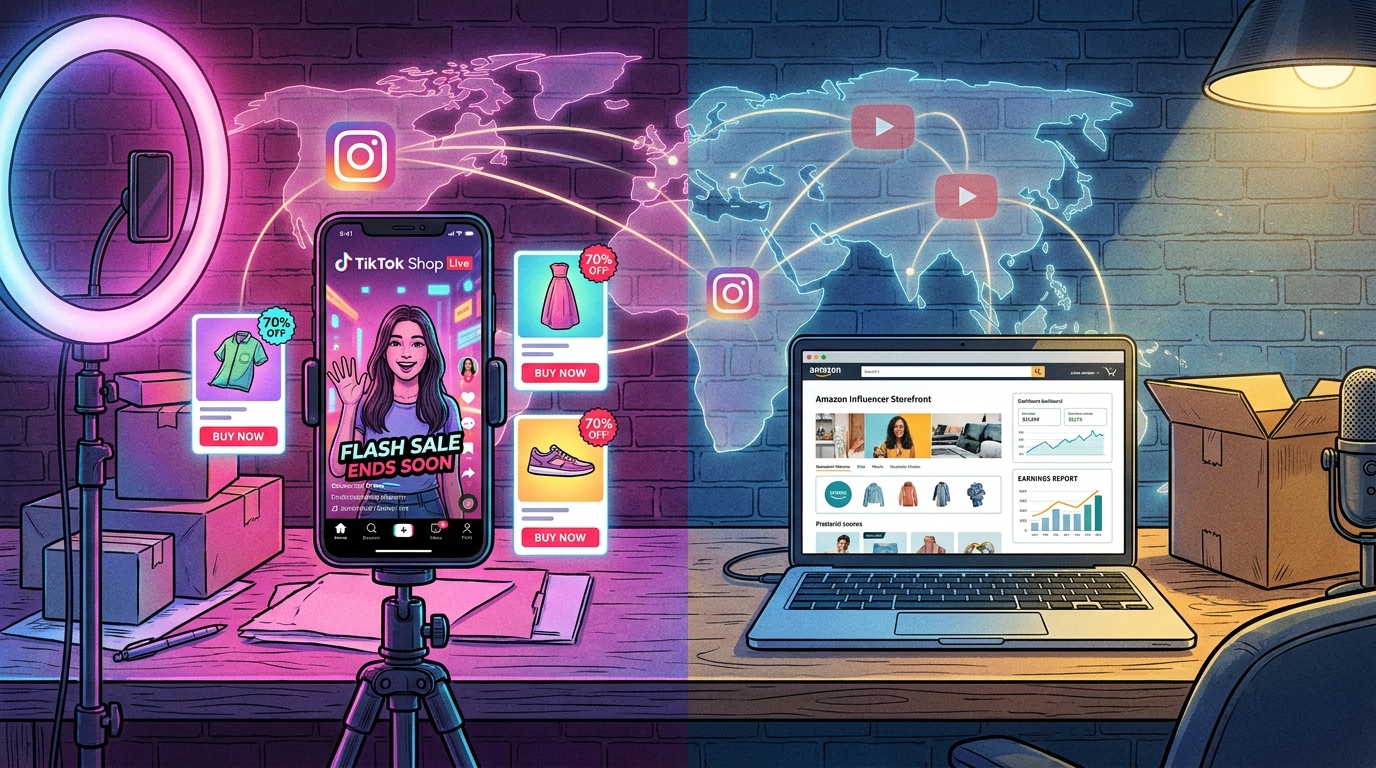
If you feel like everyone is giving you opposite advice right now, you are not crazy. One person says go all in on TikTok Shop because that is where discovery happens. Another says stick with Amazon because buyers trust it and Prime Day is coming. That leaves a lot of creators stuck in the middle, posting everywhere, testing everything, and not really building momentum anywhere. Fresh research is making the split a lot clearer. Creators are not all playing the same game anymore. They are quietly separating into two camps: TikTok Shop-first creators and Amazon-first creators. Each group has different traffic sources, different content styles, and very different ideas about what a “good” payout looks like. If you are trying to build a real TikTok Shop vs Amazon Influencer strategy 2026 plan, the biggest mistake is acting like both systems reward the same behavior. They do not.
⚡ In a Hurry? Key Takeaways
- TikTok Shop and Amazon Influencer now reward two different creator styles, so trying to split your focus evenly usually slows growth.
- Pick your main ecosystem based on where your sales actually start: discovery-led short video means TikTok Shop, high-intent search traffic means Amazon.
- Protect your time and margins by using Instagram and YouTube to support your main channel, not as random side experiments.
The split is real, and it matters more than people want to admit
Ahead of Prime Day, more creators are looking at their numbers and seeing a pattern. TikTok Shop-first creators tend to win with momentum, volume, and impulse buying. Amazon-first creators tend to win with buyer intent, search behavior, and conversion trust.
That sounds simple, but it changes almost everything.
If you are TikTok Shop-first, your job is to get attention fast and make the product feel instantly useful, fun, or urgent. If you are Amazon-first, your job is to help someone who is already close to buying feel confident enough to click through and finish the purchase.
Those are not small differences. They affect your script, your posting schedule, your editing style, your brand deals, and how patient you need to be waiting for results.
What a TikTok Shop-first creator usually looks like
Discovery is the engine
TikTok Shop-first creators are usually strong at making products feel native to the feed. Their content often starts with a hook, a problem, a surprising result, or a personal reaction. The sale happens because the content creates desire before the shopper even planned to buy.
In plain English, TikTok Shop is often better when you are good at making people stop scrolling.
Payouts can look bigger, but margins get messy
This is where many creators get tripped up. A TikTok Shop campaign can look exciting because order volume moves quickly, samples show up, and affiliate rates can seem generous. But if you rely too much on deep discounts, coupon stacking, or low-margin items, your business can get flimsy fast.
You may get activity without getting stability.
That is why TikTok Shop-first creators need to watch actual net earnings, not just gross sales screenshots. A campaign that looks hot on social can still be weak once returns, inconsistent commissions, and discount expectations pile up.
Content style matters more than polish
TikTok Shop usually rewards speed, relevance, and repeat testing. Fancy production is not the point. Clear payoff is. The creators doing best here often post a lot, react quickly to trends, and remake the same angle in different versions until one catches.
If you hate rapid testing, TikTok Shop can feel exhausting.
What an Amazon-first creator usually looks like
Intent is the engine
Amazon-first creators are often feeding people who are already in shopping mode. The customer may have searched on Amazon already, seen a review on YouTube, or clicked from Instagram because they want reassurance before buying.
That means the content job is different. You are not always creating desire from scratch. You are helping remove hesitation.
Trust and catalog depth matter
Amazon-first creators often do better when they build a library. Think product reviews, comparisons, “best under $50” roundups, restock picks, and niche recommendations. This is less about one viral hit and more about stacking useful assets that can keep earning over time.
That can feel slower. It can also feel more stable, at least when the platform reporting and commission setup are working in your favor.
Of course, many creators have learned the hard way that Amazon is not always as steady as it looks. If that sounds familiar, it is worth reading Why Creators Are Quiet Quitting Amazon Influencer And Flocking To TikTok, Instagram And YouTube Shopping. It captures the frustration many creators are feeling around flat views, weaker commissions, and murky reporting.
Amazon-first creators usually think in conversion, not virality
If your brain naturally goes to keywords, evergreen videos, shopping intent, and buyer trust, Amazon may fit you better than TikTok Shop. You do not need every post to explode. You need the right shoppers to click and buy.
Why sitting in the middle is risky
A lot of small creators tell themselves they are “diversified” when really they are just scattered.
They make TikTok-style videos for Amazon. They make Amazon-style reviews for TikTok. They treat Instagram and YouTube like separate full-time jobs instead of support channels. Then they wonder why none of it compounds.
The problem is not using multiple platforms. The problem is using them without a center.
The best creators usually have a home base. Then they use other platforms to feed it.
- If TikTok Shop is your main game, Instagram Reels and YouTube Shorts can replay your strongest hooks and send more attention back to your product story.
- If Amazon is your main game, YouTube can build longer-form trust and Instagram can warm up your audience before they hit your storefront or links.
That is a much cleaner system than trying to build three unrelated businesses at once.
How to choose your camp on purpose
Choose TikTok Shop-first if these sound like you
You are good on camera. You can hook people quickly. You do not mind posting often. You are comfortable testing lots of angles. Your audience buys from emotion, convenience, novelty, or visible transformation.
You probably fit TikTok Shop-first if your best content makes people say, “I didn’t know I needed that.”
Choose Amazon-first if these sound like you
You are good at explaining differences between products. You like review content. You can create useful evergreen videos. Your audience asks practical questions and wants proof before buying.
You probably fit Amazon-first if your best content helps people say, “Okay, now I know which one to get.”
If you are still unsure, check where the buying journey starts
Ask yourself one basic question: are people discovering the product because of me, or are they finding me when they are already close to buying?
If discovery starts with you, TikTok Shop may be the better lead channel.
If shopper intent already exists before they see you, Amazon may be the better main system.
What to do ahead of Prime Day
This is the part that matters right now.
Prime Day tends to pull brand attention toward Amazon. That can be good news if you are Amazon-first, but it can also pressure TikTok-first creators into chasing a playbook that is not actually theirs.
Do not switch your whole strategy just because brand briefs get louder in June and July.
Instead:
If you are TikTok Shop-first
Protect your margins. Be picky about products that need huge discounts to convert. Use Prime Day noise as comparison content, deal reaction content, or “better than the Prime Day version” content if that is honest and useful.
And when brands push Amazon-only thinking, negotiate from your actual strength. If you create demand on TikTok, that has value even if the brand is fixated on Amazon reporting.
If you are Amazon-first
Build intent content now, not the day before the event. Create comparison posts, budget lists, category guides, and simple recommendation videos that can catch shoppers while they are researching. Prime Day is rarely won by panic-posting.
It is usually won by already being useful when the buying window opens.
Use Instagram and YouTube as amplifiers, not distractions
This is one of the easiest fixes for small creators.
You do not need a separate master plan for every app. You need supporting roles.
For TikTok Shop-first creators
Use Instagram to repeat your strongest product moments and build familiarity. Use YouTube Shorts to extend reach on proven hooks. If a product story keeps working, then maybe turn it into a longer YouTube explainer.
For Amazon-first creators
Use YouTube for richer reviews, side-by-side demos, and search-friendly content. Use Instagram Stories or Reels to remind your audience about restocks, deal windows, and top picks. Keep the message simple and buyer-focused.
Think of these channels as amplifiers for your core system, not extra jobs to feel guilty about.
The best TikTok Shop vs Amazon Influencer strategy 2026 is usually simpler than people think
Pick a primary ecosystem. Match your content style to how that ecosystem pays. Use the other platforms to support that choice.
That does not mean you can never expand. It means you stop treating expansion like your starting point.
If you begin with clarity, your next three months get a lot easier. Your testing gets cleaner. Your brand conversations get smarter. Your content starts to sound like it belongs somewhere instead of being copied from creators in a completely different lane.
At a Glance: Comparison
| Feature/Aspect | Details | Verdict |
|---|---|---|
| Main traffic source | TikTok Shop usually starts with feed discovery and impulse interest. Amazon Influencer usually starts with shopper intent, search behavior, or trust-based clicks. | Choose TikTok if you create demand well. Choose Amazon if you convert existing demand well. |
| Best content style | TikTok rewards fast hooks, quick demos, and frequent testing. Amazon works better with reviews, comparisons, and evergreen recommendation content. | Match the platform to your natural content strengths. |
| Payout expectations | TikTok can produce faster spikes but often needs margin discipline. Amazon can feel steadier, but reporting and commissions may be less reliable than creators expect. | Do not chase headline revenue. Track net earnings and platform fit. |
Conclusion
Right now, ahead of Prime Day, the smartest move is not doing more. It is choosing more clearly. Fresh research is showing a real divide between TikTok Shop-first and Amazon-first creators, with different primary platforms, traffic patterns, and payout expectations. If you understand those two ecosystems and pick a side on purpose, you can stop copying generic playbooks and start building around how you actually sell. That means leaning into the algorithm that fits your content style, using Instagram and YouTube as amplifiers instead of distractions, protecting margins on TikTok Shop, and negotiating more confidently with brands that only care about Amazon. Most of all, it helps you avoid wasting the next three months on features and experiments that were never a fit for your business in the first place.