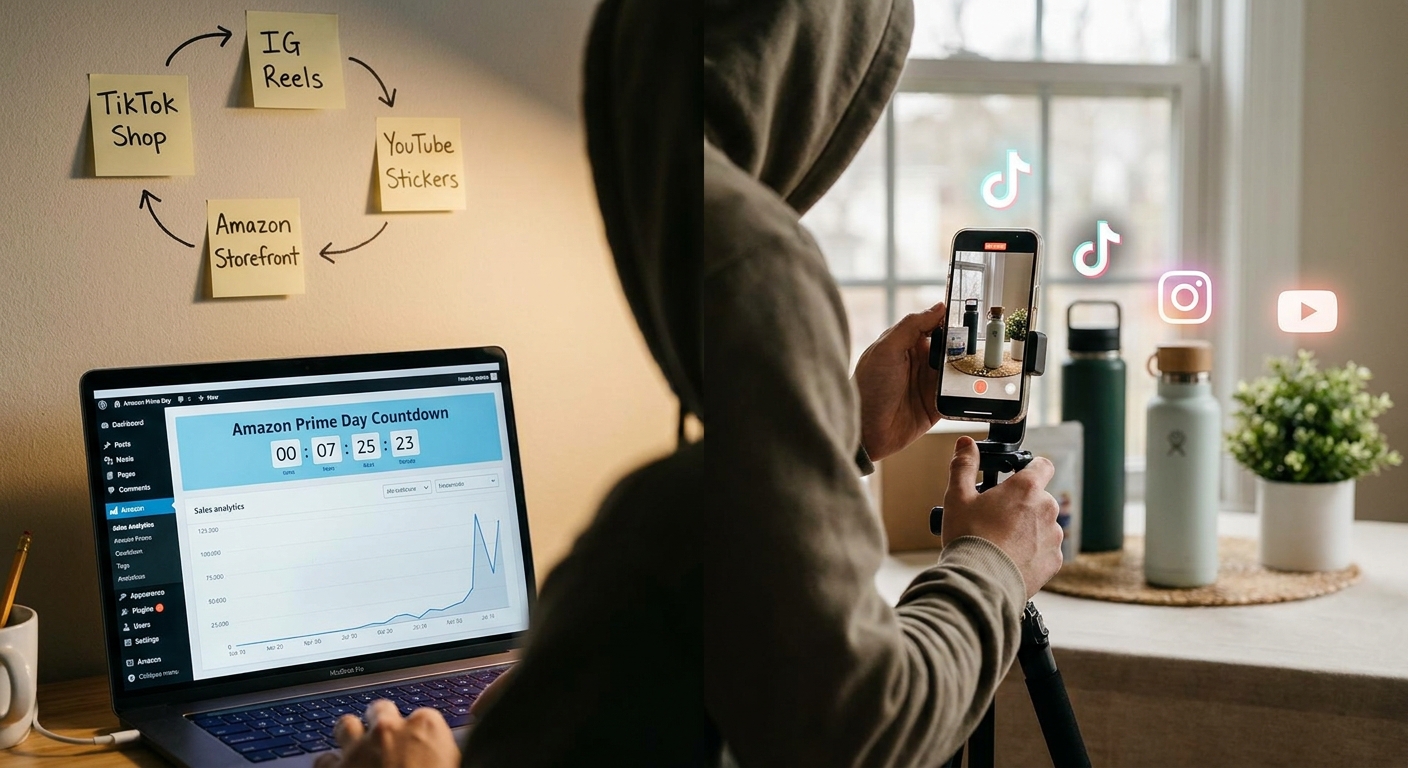
Your feed is probably a mess right now. Prime Day this. Lightning deal that. Coupon code everywhere. It is noisy, repetitive, and honestly a little annoying. But buried inside that spam storm is a very real opportunity. Big creators, Amazon storefront operators, TikTok sellers, and Instagram affiliates are no longer treating Prime Day like a two day event. They quietly stretch it into a month of buying behavior. That is the new Prime Day piggyback. They use Amazon’s giant ad push to catch attention on TikTok, Instagram, YouTube Shorts, and Amazon posts, then keep converting shoppers long after the “official” sale ends. The good news is you do not need a giant audience or a warehouse full of products to do this too. If you are a solo creator, small shop, or side hustle brand, you can build a simple Prime Day social commerce strategy for TikTok Shop Instagram and Amazon Influencers that works this week and keeps working through the rest of July.
⚡ In a Hurry? Key Takeaways
- Prime Day is no longer just a sale event. Smart creators use it as a 30 day traffic wave across TikTok, Instagram, YouTube, and Amazon.
- Start with short videos built around search intent, real product use, and “best under” lists you can repost in different formats all month.
- Do not rely on fake urgency. Content that still helps after the discount ends will earn more trust and often more sales.
What the “Prime Day piggyback” really means
Think of Prime Day as the starter pistol, not the finish line.
Amazon spends huge money training people to shop in July. That changes behavior everywhere. People start searching for “best Prime Day finds,” “TikTok made me buy it,” “home deals,” “back to school gadgets,” and “creator storefront picks.” Even when they are not inside Amazon yet, they are already in shopping mode.
That is why social platforms light up at the same time. TikTok creators post quick demos. Instagram creators build story frames and reels. YouTube Shorts channels publish roundup clips. Amazon Influencers update storefront idea lists and product videos. The sale week becomes the excuse. The real goal is to build a month of purchase intent.
For smaller publishers and creators, this is good news. You do not have to outspend anyone. You just need to show up in the right format, on the right channel, at the right moment.
Why the usual “best deals” post falls flat
Most sale content dies fast because it is too generic.
“Top 50 Prime Day Deals” sounds useful, but it usually has three problems. First, everybody is making the same list. Second, the content expires the minute prices change. Third, it does not build trust because there is no point of view.
The better play is to make content with a shelf life. Instead of “today only discounts,” focus on “products worth buying if the price drops,” “things I actually use,” “best budget desk setup under $100,” or “three small kitchen upgrades that fix everyday annoyances.”
That way, your clip still works after Prime Day. You can simply update the caption, link set, or storefront order.
The channel by channel system that works this week
1. TikTok: Catch search traffic and impulse buys
TikTok is where a lot of discovery starts. People are not always searching like they do on Google, but they are absolutely hunting for buying ideas. During Prime Day week, TikTok fills up with deal talk, comparison videos, product demos, and “run, don’t walk” recommendations.
To use that wave, make short videos around one product or one tight theme. Keep it simple.
- “3 Prime Day desk finds under $25”
- “I bought the viral mini printer so you do not have to”
- “Best travel gadget if the Prime Day price comes back”
- “What is actually worth buying from my Amazon cart”
The key is not just the deal. It is the use case. Show the item solving a real problem in the first few seconds. A cable organizer untangling a nightstand. A portable blender making breakfast. A posture cushion changing a work chair. That is what gets people to stop scrolling.
If you have TikTok Shop access, great. If not, you can still use TikTok to push traffic to your Amazon storefront, affiliate links in bio, or a link hub. Just be clear and honest.
What to post on TikTok this week
- One “best under $25” video
- One honest review of a product you already use
- One comparison video, cheap option vs upgraded option
- One “Prime Day misses” video, which builds trust fast
That last one matters. If everything is “must buy,” viewers tune out. Saying “skip this, buy that” makes you sound human.
2. Instagram: Turn interest into saved posts and story clicks
Instagram works a little differently. Reels can still pull discovery, but Stories and carousels are often where buying intent gets organized. People save posts. They send them to friends. They tap through product tags. They come back later.
This makes Instagram a good place to turn your fast TikTok ideas into cleaner, more polished shopping content.
Try this structure:
- Reel: quick hook plus one product demo
- Carousel: “5 Prime Day buys I would repurchase”
- Stories: price drop alert, poll, question sticker, link sticker
- Highlight: “July Deals” so the content stays easy to find
Instagram is especially good for bundling. Instead of one item per post, group products by problem. Dorm room basics. Tiny apartment storage. Summer travel carry-on picks. Home office fixes. New parent shortcuts.
That makes your content useful after the sale too. The products can change. The problem stays the same.
3. Amazon Influencers: Build the shelf that catches late buyers
This is the part many people skip, and it is where the long tail shows up.
If you are in the Amazon Influencer Program, your storefront, idea lists, and shoppable videos should not just be a random pile of links. During Prime Day season, treat your storefront like a landing page.
Create sections like:
- Best Prime Day Home Upgrades
- Under $50 Finds I Actually Use
- Back to School Tech Picks
- Travel Essentials for July
Now your TikTok and Instagram posts have somewhere better to send people than a giant messy homepage. It also helps after sale week, because people who saw your clip on Tuesday may not buy until next Friday.
Amazon rewards relevance and volume over time. A clean storefront with focused lists and product videos can keep converting when social posts slow down.
How to make one asset work across all platforms
You do not need 20 separate ideas. You need one good idea, cut three ways.
Let’s say you film a 30 second clip about a portable charger.
- TikTok version: “This is the one travel gadget I stop packing without”
- Instagram Reel version: tighter edit with on-screen text and cleaner captions
- Amazon video version: straightforward product demo with practical details
Then build support around it.
- Instagram Story: “Want my full travel list?”
- Amazon idea list: “Carry-on essentials”
- TikTok follow-up: “Three things that fit in my personal item”
Same product. Same filming session. Multiple doors into the same buying funnel.
What content keeps converting after Prime Day ends
This is where the quiet money is.
The best posts during sale season are not only about urgency. They are about usefulness. Once the official discounts end, shoppers still buy because they are now in research mode. They saw the item. They saved the reel. They remember the demo. They wait for payday, compare options, or come back later.
So build content around these durable angles:
- Products you have used for at least a few weeks
- Before and after improvements
- Problem and fix videos
- Budget tiers, under $25, under $50, under $100
- Roundups by room, task, or lifestyle
A “best Prime Day deals” post expires. A “five apartment gadgets that make small kitchens easier” post lasts.
How to ride trends without looking spammy
This matters more than people admit.
Shoppers can smell lazy affiliate content from a mile away. If your posts feel like endless hype, they bounce. The fix is simple. Be specific. Be selective. Show proof.
Do this
- Say why an item is useful in daily life
- Show it in your hand, home, bag, or desk
- Point out flaws as well as benefits
- Use plain captions with searchable phrases
Skip this
- Fake countdown panic
- Ten products jammed into one confusing clip
- Copying someone else’s exact picks
- Posting links with no real opinion
The best Prime Day social commerce strategy for TikTok Shop Instagram and Amazon Influencers is not louder content. It is clearer content.
A simple 7 day publishing plan
If you are starting late, do not panic. Here is a realistic week.
Day 1
Pick one niche bundle. Example: work from home, travel, dorm, kitchen, beauty, fitness.
Day 2
Film 5 to 7 quick product demos. Keep each one under 20 seconds raw.
Day 3
Post one TikTok, one Reel, and upload one or two Amazon product videos.
Day 4
Create an Instagram carousel and a Story set with links or product tags.
Day 5
Build or clean up your Amazon storefront lists so traffic has somewhere useful to go.
Day 6
Post a comparison clip or “what I would skip” video. Trust builder.
Day 7
Review what got saves, clicks, comments, and watch time. Repost winners with a slightly new hook.
This is how small creators compete. Not with more products, but with better packaging and smarter reuse.
Metrics that actually matter
It is easy to obsess over views. Views are nice. Orders are nicer.
Watch these instead:
- Save rate on Instagram carousels and reels
- Story link taps
- TikTok watch time past 3 seconds
- Comments asking for the link or product name
- Amazon storefront clicks and ordered items
- Which product themes convert better than others
Sometimes the clip with 2,000 views makes more money than the one with 200,000 because it matched buyer intent better.
For tiny brands, not just influencers
If you sell your own products, this still applies.
You can piggyback on Prime Day attention even if your main sales are on Shopify, Etsy, TikTok Shop, or your own site. The trick is to join the shopping conversation without pretending to be Amazon.
Examples:
- “If you are deal hunting this week, here are my favorite small upgrades for your desk”
- “Not everything good is on Prime Day. Here is our July bundle”
- “Three products our customers buy together during summer travel season”
You are borrowing the audience’s shopping mindset, not copying the giant marketplace.
At a Glance: Comparison
| Feature/Aspect | Details | Verdict |
|---|---|---|
| TikTok discovery | Fast hooks, demos, trend-based search interest, strong for impulse shopping and top-of-funnel attention. | Best for getting noticed quickly. |
| Instagram conversion support | Reels for reach, Stories for clicks, carousels and Highlights for saved shopping guides people revisit later. | Best for trust and repeat visits. |
| Amazon storefront longevity | Idea lists, product videos, and organized collections catch late buyers after the sale noise fades. | Best for the long tail and cleaner purchase path. |
Conclusion
Right now is the moment to act because Amazon’s July sale cycle and Prime Day window are already pushing shoppers into research and buying mode across TikTok, Instagram, YouTube, and Amazon itself. You do not need one more giant “best deals” article that goes stale tomorrow. You need a practical system. Start with a few useful product clips, shape them for each platform, send people to a clean storefront or list, and keep the posts valuable after the discounts end. That is how you ride the current search and hashtag wave without burning out. More importantly, it gives solo creators and tiny brands a real shot at turning somebody else’s mega event into their own long tail social commerce funnel for the rest of July.